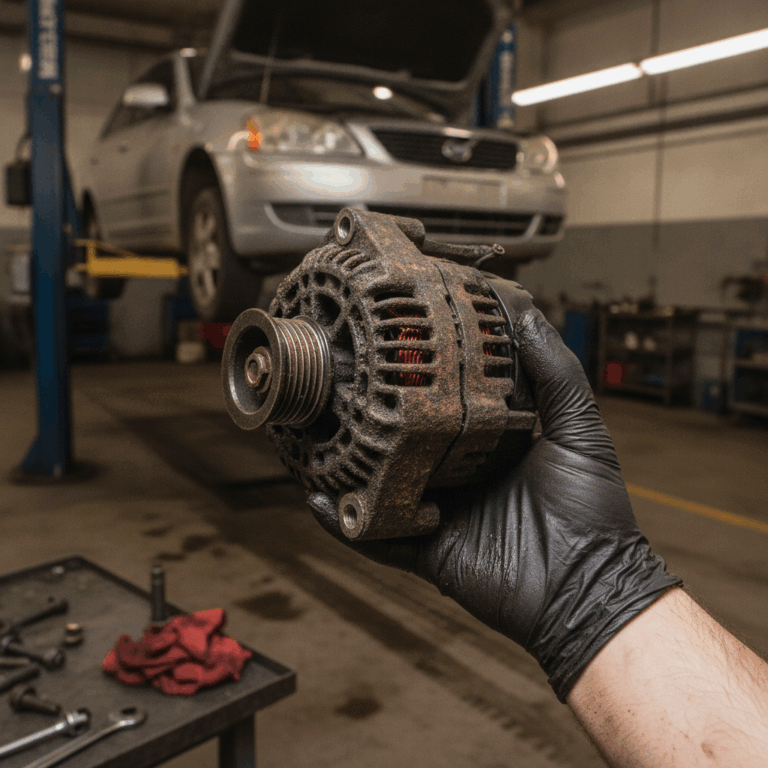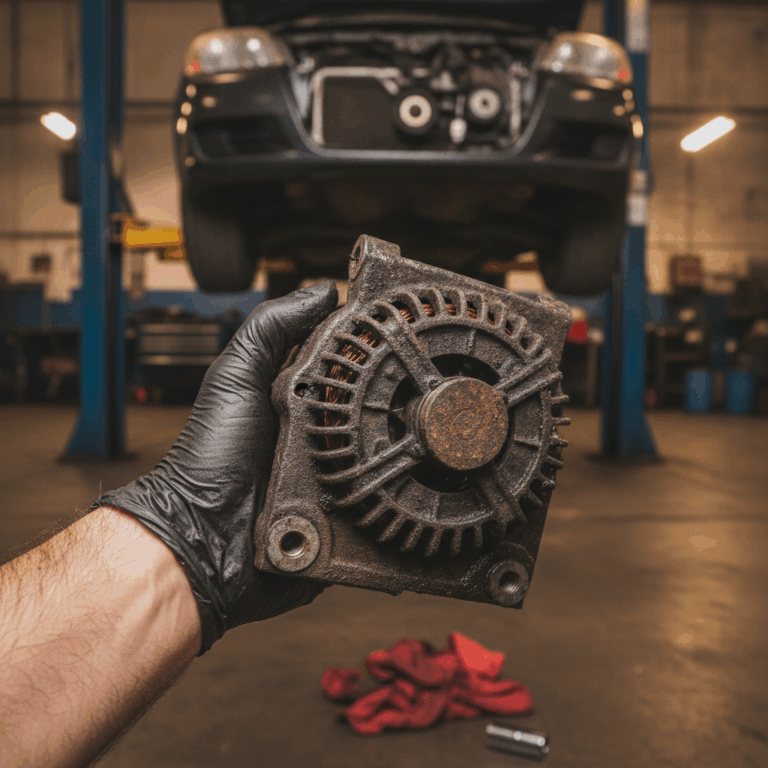
Battery light came on, the headlights dimmed at the next stoplight, and now the car barely cranks. That’s textbook bad-alternator behavior, and a shop quote of $642, $750, or $1,100 is on the way. The alternator is the belt-driven generator (older service manuals call it the AC generator) that keeps the battery topped off and runs every accessory while the engine is on. When it dies, the battery does the heavy lifting until it doesn’t.
In 2026, a typical alternator replacement runs $350 to $1,100 all in. Parts are $150 to $900 depending on whether you go aftermarket, remanufactured, or OEM. Labor is $150 to $500 depending on how packed the engine bay is. Below is the actual breakdown, the home test that tells you whether you even need a new alternator, and where most people get burned on the quote.
Key Points to Review
- Most alternator replacements land between $350 and $1,100 total in 2026. Compact sedans sit at the low end; trucks, V6 minivans, and European cars sit at the high end.
- The part itself runs $150–$400 aftermarket, $200–$550 remanufactured, and $400–$900 OEM.
- Labor is usually 1.5 to 3 hours. A 3-hour quote isn’t automatically a rip-off. Some engine bays bury the alternator behind half the accessory drive.
- Test the battery first. A weak battery makes a healthy alternator look bad. Replacing the wrong one means you’ll be back here in a week.
- If the shop is willing, replace the serpentine belt at the same time. The belt comes off either way, so you only pay for the belt itself.
- A failing alternator gives you minutes, not hours, of driving once the warning lights come on. Plan accordingly.
Average Alternator Replacement Cost
The honest range is wide because vehicles are not built the same. Here’s what’s actually inside that range.
Parts cost ($150 to $900 depending on tier)
Three tiers, three prices. Aftermarket alternators are the cheapest, usually $150 to $400. Remanufactured (or “reman,” or “rebuilt,” same thing) units run $200 to $550. OEM, which is the unit your dealership sells in a manufacturer-branded box, is $400 to $900. Higher amp ratings push you up the scale. A 220-amp alternator for a truck with an aftermarket stereo and a winch isn’t going to cost what a 90-amp Corolla unit costs.
A note on reman quality: a properly rebuilt unit is fine. The bearings, brushes, voltage regulator, and rectifier diodes get replaced. The case and core stator get reused. Detroit Axle’s alternator catalog covers most domestic and import vehicles, and the units ship with a 10-year warranty, which is longer than most reman warranties at the auto parts counter.
Labor cost ($150 to $500, and why some shops quote 3 hours)
Labor rates run $90 to $160 an hour at an independent shop and $140 to $220 at a dealership. The book time on a “simple” alternator swap is usually 1.0 to 1.5 hours. So why does the shop quote 3?
Because the book is lying about your specific car. On a 2nd-gen Honda Pilot or a Chrysler Pacifica, the alternator is behind the engine, tucked against the firewall, and you’re removing intake plumbing, a heat shield, and sometimes a motor mount to reach it. On a transverse V6, lower-radiator-support removal is on the table. I had a Pacifica come through where the book said 1.4 hours and the actual job ate four. That isn’t padding. That’s the car.
Six years at a Toyota and Lexus shop in Fullerton taught me that the easy cars are easy and the bad cars are brutal, and there’s almost nothing in between. Civics, Camrys, and Accords: 90 minutes if nothing fights you. F-150s, Pacificas, Pilots, Tahoes: budget three hours and bring a long extension.
Is It the Alternator or the Battery?
This is the question nobody at the shop wants to slow down and answer for you, and it’s the one that costs people the most money. Roughly 80% of “my alternator is dying” calls are actually a weak battery. A weak battery makes the alternator work harder, drops the voltage at the post, and looks identical to alternator failure on a quick test. Replace the alternator first and the new one will be charging a dying battery into the ground inside a month.
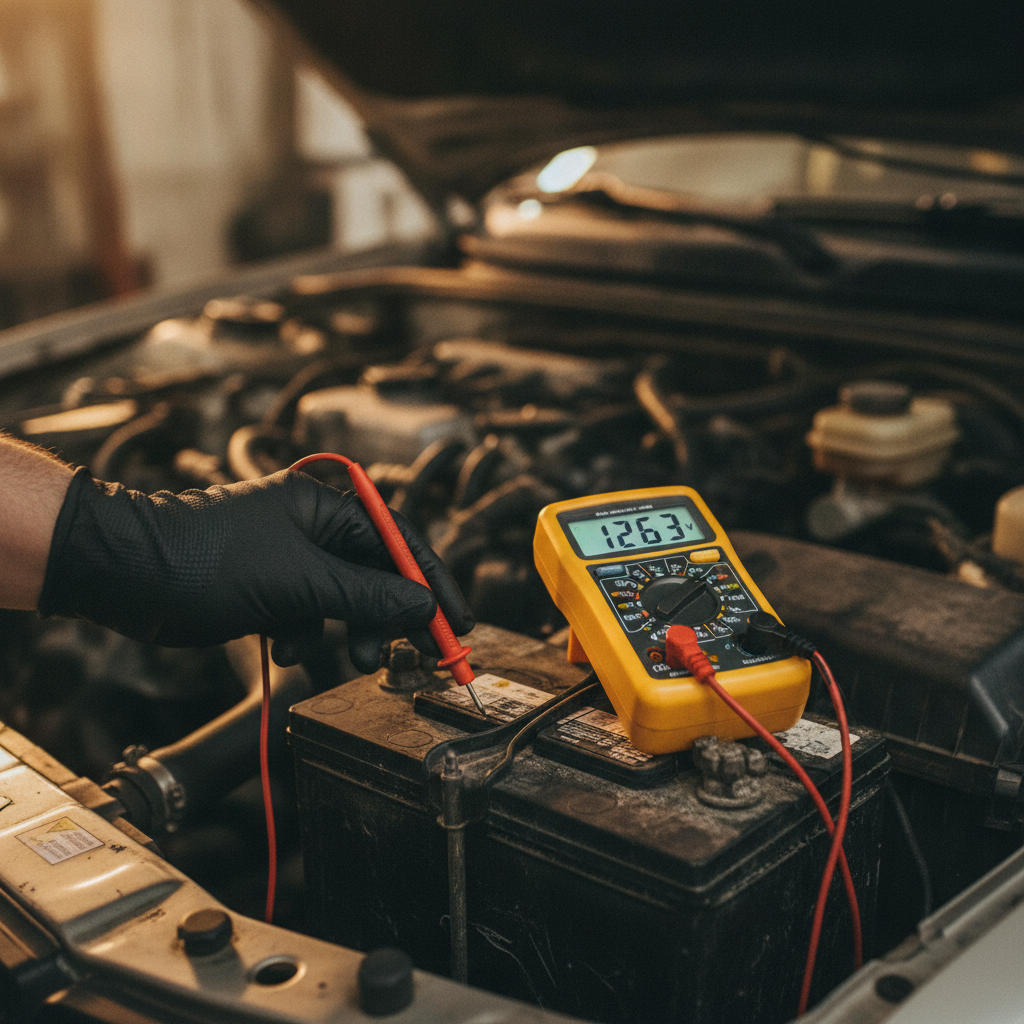
The 3-test home check (you need a $20 multimeter)
This takes five minutes in the driveway:
- Engine off, key out. Put the multimeter on the battery posts. You should read 12.4–12.7 volts. Below 12.2, the battery is weak or dying.
- Start the engine, let it idle. Re-read at the posts. You should see 13.8–14.6 volts. Below 13.2 means the alternator isn’t charging. Above 15 means the voltage regulator is failing, which is also “alternator” on the parts counter.
- Headlights on, blower on high, idle the engine. The voltage should stay above 13.5. If it sags into the 12s, the alternator can’t keep up with the load. That’s a failing unit even if it passes the first two tests.
Why a “passed” battery test at the parts store doesn’t mean the alternator is fine
The free test at the parts counter is a bench test. They clamp on, push a small load, and check the voltage curve. That’s it. It tells you the battery isn’t dead. It doesn’t tell you the battery holds a load with the AC, the rear defrost, and the headlights running, which is the only thing your alternator actually has to support. Same problem in reverse for the alternator test: passes at idle, fails the moment you turn on accessories.
A few other things that look like alternator failure but aren’t: corroded battery cables (the multimeter reads low at the post because half the cable is gone to rust), a glazed or loose serpentine belt (the alternator works, the belt slips), a parasitic draw from a stuck relay or trunk light (drains the battery overnight, gets blamed on charging), and on newer cars, a bad battery temperature sensor that tells the computer to undercharge.

Cost by Vehicle Type
Compact sedans and economy cars
Civic, Corolla, Sentra, Elantra, base Camry. Part $150–$300 aftermarket. Labor 1.0–1.5 hours. Total $300–$600 at an independent. These are the cars where DIY is realistic and where a $700 dealer quote is genuinely high.
Midsize sedans, crossovers, and 4-cylinder SUVs
Accord, Camry V6, Rogue, CR-V, RAV4, Equinox. Part $180–$400. Labor 1.5–2 hours. Total $450–$850. The variability here comes from accessory placement, not the part. Some bays open up, others don’t.
Trucks, V6 minivans, and high-amp builds
F-150, Silverado, Tahoe, Pacifica, Odyssey, Pilot. Part $250–$600 (high-amp units push higher). Labor 2.5–3.5 hours. Total $700–$1,400. The truck side adds a wrinkle: aftermarket audio, off-road lighting, or a winch usually means you need a 200+ amp unit, not the stock 130–160. Sticking the stock amperage back in is how you burn it out in a year.
Luxury and European (and a note on EVs)
BMW, Audi, Mercedes, Lexus. Part $400–$900 (OEM-only on some platforms). Labor 2–4 hours. Total $900–$2,000+. Programming may be required on newer Mercedes and BMWs, which is dealer-only on some models.
EVs don’t have alternators. Pure electric cars use a DC-DC converter to keep the 12V battery charged off the high-voltage pack. Hybrids have either a small alternator (older Prius generations) or a DC-DC setup (newer ones). If your Model 3 or Bolt is dying, it’s the 12V battery, not “an alternator.”
OEM vs. Remanufactured vs. Aftermarket
This is the single biggest lever on the bill. Most shops install whatever their parts house delivers, which is usually a midrange reman at standard markup. You can do better by sourcing the part yourself.
When each makes sense
Aftermarket new is the value play. New stator, new diodes, new bearings, new regulator. Quality varies by brand. For a daily driver out of warranty, this is what I install on my mobile jobs in Orange. It’s also what most chain auto parts stores sell as their house brand.
Remanufactured is fine if the rebuilder is reputable and the warranty is at least 2 years. Skip the cheapest reman on a parts-store shelf. The $79 special is someone’s third-life core.
OEM is worth it on luxury vehicles where the charging logic is integrated with the body computer, and on vehicles still under powertrain warranty where mixing in aftermarket can complicate a future claim. Otherwise, you’re paying for the manufacturer’s box.
What to ask about warranty and amp rating
Two questions before you hand over a credit card:
- What’s the warranty? Anything under 12 months on a reman is a flag. A quality aftermarket new unit should carry multiple years. Detroit Axle’s alternators ship with a 10-year warranty, which is the longest on the aftermarket side.
- What’s the amperage? Match it or exceed it. Going lower than the factory spec to save $40 means the unit runs at 100% output all the time and burns out early.
Can You DIY This?
When the job is a 90-minute Saturday
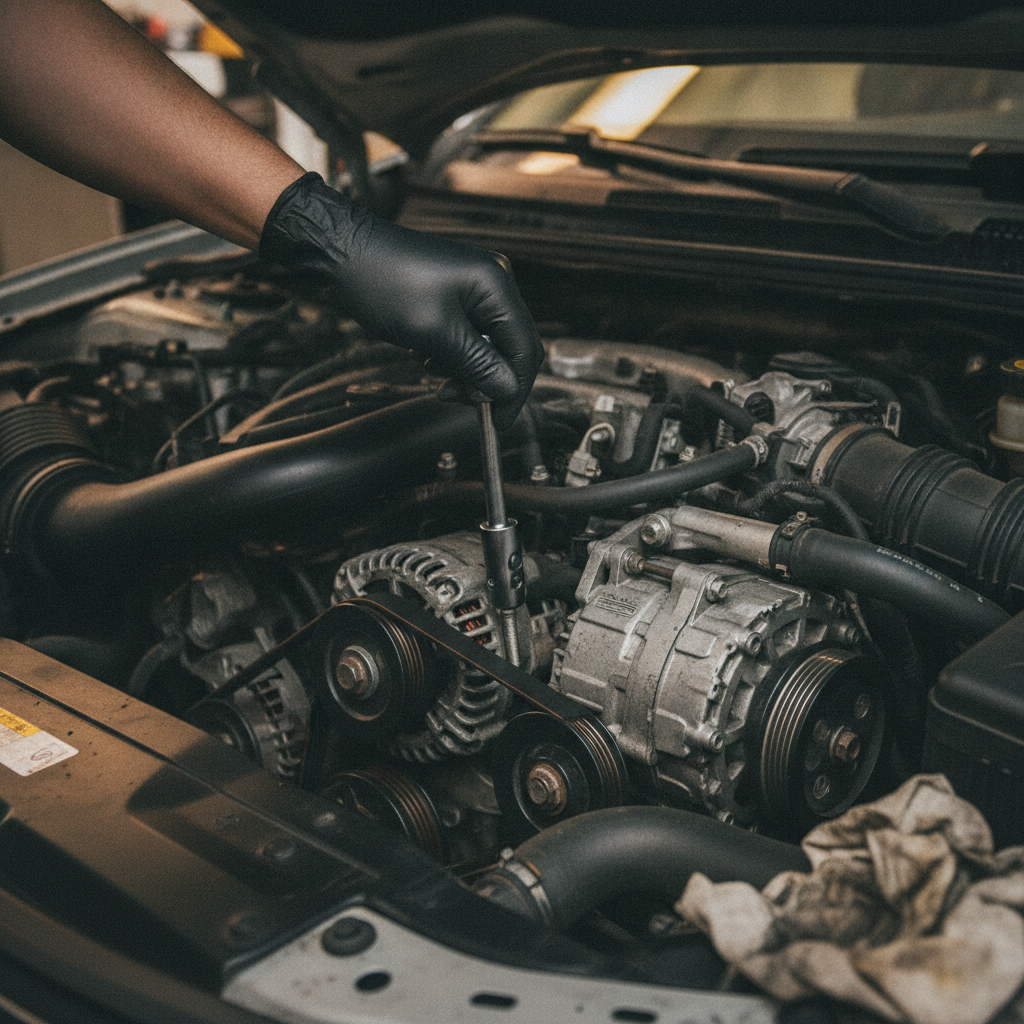
If the alternator is on top of the engine, you can see the pulley from above, and the serpentine belt route is clear, this is a beginner-friendly job. Tools: a metric socket set, a serpentine belt tool or a long ratchet on the tensioner, a 10mm wrench for the battery, and a multimeter to confirm the new unit is charging before you button up. On a Camry or a Civic, you’ll be done in an hour and a half including the test drive.
When it absolutely isn’t (and what makes it not)
Skip the DIY if the alternator is behind the engine against the firewall, if you can’t see the pulley without a flashlight and a mirror, or if the belt routing involves removing the motor mount. Pacifica V6, 2nd-gen Pilot, some Ford 3.5 EcoBoost trucks, most Subarus where the alternator is buried at the bottom of the timing belt side. Had a guy in Orange try a Pacifica swap in his driveway and end up trailering it to me with the intake half-disassembled. The book says 1.4 hours. Reality on that platform is closer to four. Pay the labor.
Also skip DIY if the vehicle requires post-install programming (some 2010+ Mercedes, BMWs with intelligent battery sensors). The alternator will install fine and then throw codes until a scan tool resets the charging strategy.
How to Save Money on Alternator Replacement
Buy the part separately and pay only labor
Most independent shops will install a customer-supplied part. The catch is they won’t warranty it, since they didn’t sell it. That’s fine. Your warranty comes from wherever you bought the part. A $200 aftermarket unit with a 10-year warranty plus $200 of labor is $400 total. The same job through the shop’s parts house is often $750.
Replace the serpentine belt at the same time
The belt has to come off to access the alternator on most vehicles. If your belt is over 60,000 miles or shows any glazing or cracking, replace it now. You’re only paying for the belt itself, which is usually $25–$60. Doing it later means paying the labor twice.
Don’t replace a healthy alternator because a “new” battery is dying
The most expensive mistake I see is owners who jump a dying car, drive to AutoZone, get a free battery test that “passes,” and assume the alternator must be the problem. They drop $800 at a shop. The new alternator can’t fix a battery with bad cells, and a week later the car is dead again. Test the battery under load before touching the alternator. If the battery is more than 4 years old, it’s also a candidate even if it tested fine yesterday.
One more practical note: a failing alternator usually gives you a small driving window once the battery light comes on. Once the warning is solid red and accessories start cycling off, you have minutes, not hours. AAA recommends calling for a tow at that point rather than pushing for the next exit, because power-assist steering and power-assist brakes both lean on the 12V system that’s about to die.
FAQs
How do I know if my alternator is bad vs. my battery?
The fastest home test is the multimeter check above: engine off should read 12.4–12.7V, engine running should read 13.8–14.6V. If the engine-off voltage is fine but the engine-running voltage doesn’t climb, the alternator isn’t charging. If the engine-off voltage is in the 11s, the battery is the problem first, and you should retest after the battery is replaced or recharged. The cheap test: turn on the headlights with the engine off, then start the car. If the headlights brighten noticeably when the engine starts, the alternator is working. If they stay the same or get dimmer, it isn’t.
Can I drive with a failing alternator?
Driving with a failing alternator is a question of how many miles, not whether. Once the battery light is on, the car is running on stored battery power. You usually have 20 to 60 minutes of normal driving, less if it’s night and the headlights are on. Once accessories start cutting out (radio, fan, dash lights flickering), you’re inside the last 5–10 minutes. The real risk is stalling in traffic with no power assist on the brakes or the steering, which is one of the breakdown scenarios NHTSA highlights in its vehicle-safety guidance. Get home or to a shop. Don’t try to make a 50-mile commute.
How long does an alternator last?
Most factory alternators last 80,000 to 150,000 miles. Heat is the killer. A car that sits in stop-and-go traffic in Phoenix won’t get what a highway car in Oregon gets. So is electrical load: aftermarket stereos, lift-bar lighting, and seat heaters all shorten the life. If you’ve never replaced one and the car is over 120,000 miles, you’re on borrowed time.
Why is my mechanic quoting 3 hours of labor for an alternator?
Quoting 3 hours of labor for an alternator isn’t automatically padding. The book time depends on the vehicle. On packed engine bays like the Pacifica V6, 2nd-gen Pilot, or some Ford EcoBoost trucks, the alternator is buried behind the engine and the actual time is 2.5 to 3.5 hours. If the quote is 3 hours on a Civic or a Camry, push back. If it’s 3 hours on a transverse V6 with the alternator at the firewall, the shop is being honest.
Should I replace the battery at the same time?
Replacing the battery at the same time as the alternator is worth doing if the battery is over four years old or has been deep-discharged repeatedly. A new alternator’s first job is to recharge whatever battery is in the car, and pushing 14.5V into a battery with bad cells for an hour straight is hard on the new alternator. If the battery is under three years old and tests well under load, leave it.
If your job needs new parts and you want a real warranty, Detroit Axle’s starter catalog covers the other half of the charging-and-start system (a common companion failure on older vehicles), and most units ship with a 10-year warranty and 2–4 day delivery.