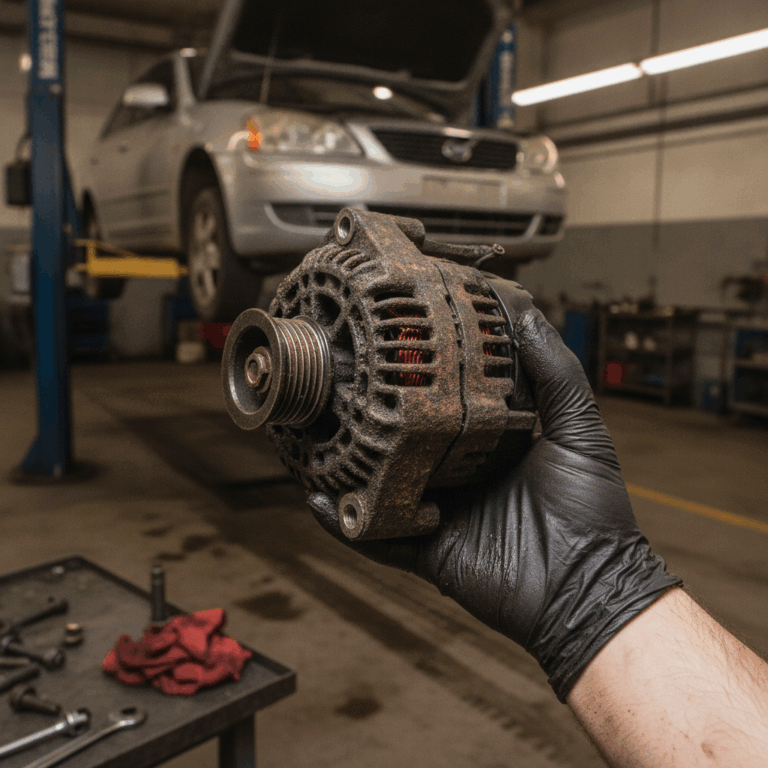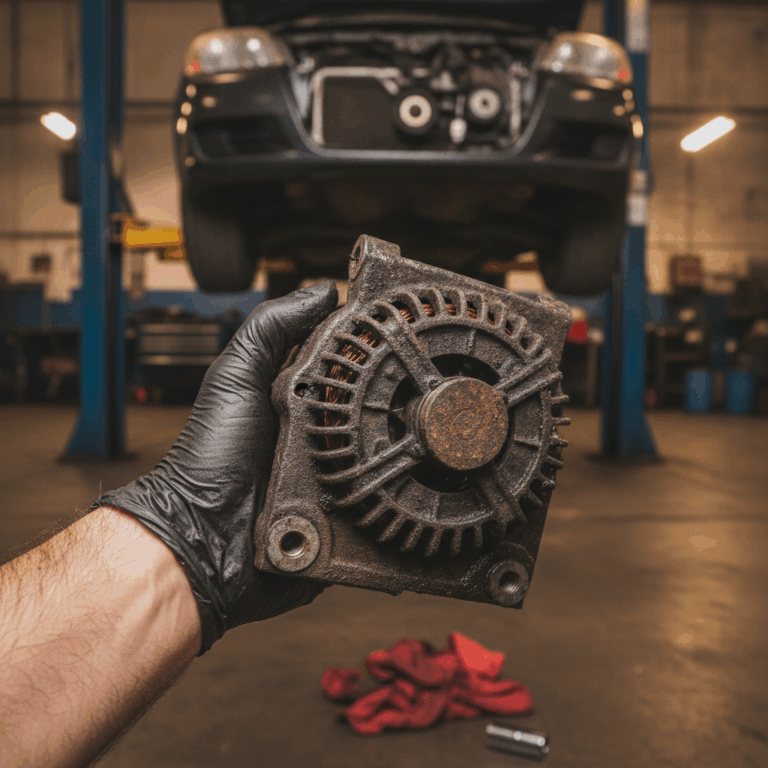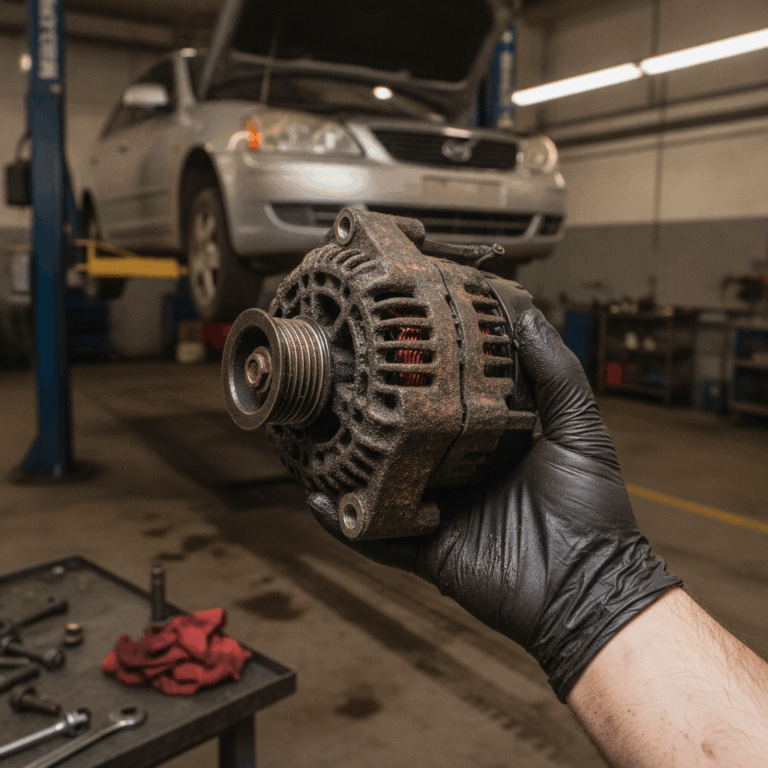
Battery light came on at a stoplight. The headlights are dim, the radio reset itself twice on the drive home, and now the car cranks slow or won’t start at all. That’s textbook bad-alternator behavior. The part you’re looking at is the engine-driven generator (also called the charging system) that keeps the battery topped up and powers every electrical load while the car runs. When it starts to fail, the symptoms cascade fast, and the order they show up in tells you how close you are to being stranded.
Below are the seven warning signs I see most on the shop floor, plus the diagnostic split between a dying alternator and a dying battery. Half the people who walk in convinced it’s one part are wrong about which.
Key Points to Review
- The dashboard battery icon is a charging system warning, not a battery warning. When it lights up while you’re driving, the alternator is the first suspect.
- Healthy alternator output: 13.8 to 14.7 volts at the battery terminals with the engine running. Anything under 13 volts and you’re running on battery reserve.
- A failing alternator will kill a brand-new battery in days to weeks. Replacing the battery without testing the charging system is the #1 wasted repair.
- You can usually drive 30 to 60 minutes on the battery alone before the car stalls. Less at night or in bad weather with headlights, wipers, and defrost running.
- An AutoZone bench test passing does NOT mean the alternator is good. Diodes and voltage regulators often fail intermittently when hot.
- Alternators last 80,000 to 150,000 miles on average. If yours is past that and the symptoms below are showing up, don’t gamble.
The 7 Most Common Bad Alternator Symptoms
These don’t all show up at once. The dash light usually comes first, then the headlights start misbehaving at idle, then the battery can’t hold a charge overnight. By the time you’re hearing the alternator make noise or smell something hot, you’re in the back half of the failure window.
1. Battery Warning Light on the Dashboard
The dashboard battery icon turning on while the engine is running is the single clearest sign of a bad alternator, because that icon is wired to monitor charging voltage, not battery condition. When the alternator stops sending the regulator the voltage it expects to see (usually around 14 volts), the light comes on. People miss this constantly because the icon looks like a battery, but the battery itself almost never triggers it while you’re driving.
Sometimes the light flickers with engine RPM. Sometimes it pulses on at idle and off when you give it gas. Both patterns mean the alternator is producing voltage inconsistently, and that’s a charging system flagging itself before it dies completely. Don’t ignore it because it’s “intermittent.” Intermittent is how this always starts.
2. Headlights Dim, Flicker, or Pulse With Engine Speed
Headlights that go dim at idle and brighten when you rev the engine are an alternator giving up under load. The alternator’s output is tied to how fast the engine is turning, so at idle, output drops, and a healthy alternator still puts out enough to hold steady. A failing one can’t, so the lights breathe with the RPMs. You’ll see the same pattern in interior dome lights, the radio backlight, and the dash gauges.
This one’s worse at night because that’s when the headlights are loaded and you’re looking right at them. Customers describe it as the lights “pulsing” or “breathing.” Once you see it, you can’t unsee it, and it’s almost always the alternator.
3. Dead Battery, Especially a Brand-New One
A dead battery that comes back after a jump and dies again the next morning is one of the loudest signs of a bad alternator, because a healthy charging system replenishes everything the battery loses overnight. When the alternator can’t keep up, the battery runs down a little more every drive cycle, and you wake up to a no-start. New battery, same thing. I’ve had customers come in twice in a month with a fresh battery from the same chain store before someone finally tested the alternator and found the actual culprit.
The diagnostic version: if the car starts fine off a jump or off the charger, drives normally for a while, then cranks slow or won’t crank the next time, the battery is doing all the work and the alternator is doing none.
4. Electrical Accessories Acting Up
Power windows running slower than normal, the radio resetting itself, gauges sweeping randomly, the climate fan changing speeds without you touching it. These are all symptoms of an alternator delivering voltage that’s drifting around instead of holding steady at 14 volts. Modern cars are full of computers that don’t like inconsistent power, so they start glitching long before the engine actually quits running. The infotainment screen rebooting mid-drive is a classic.
The pattern that sells it: multiple accessories acting weird at the same time, not one bad window switch or one bad radio. If everything electrical is misbehaving at once, the common denominator is the supply, not each individual device.
5. Whining, Grinding, or Squealing From the Engine Bay
A whine or grind under the hood that gets louder as you turn on accessories means the alternator’s internal bearings are toast. The alternator spins thousands of RPM off the serpentine belt, and when those bearings dry out or get contaminated, you hear it. Bearing whine tends to be a higher-pitched, constant tone that rises with engine speed. Grinding means metal-on-metal. That one’s terminal.
A squeal at startup that fades after a few seconds is usually the serpentine belt slipping on the alternator pulley, which is a related but separate problem. If the belt is glazed, or the alternator pulley is dragging because the bearings are seizing, you get the same symptom. Either way, pop the hood and listen with a long screwdriver to the back of the alternator. If the noise is loudest there, you found it.
6. Burning Rubber or Hot Electrical Smell
A burning-rubber or hot-wiring smell coming from the engine bay is a serpentine belt slipping on a binding alternator pulley, or it’s the alternator itself overheating internally. Both are bad. The belt smell is sharper, more like burnt rubber from a worn tire. The electrical smell is more like overheated insulation, sometimes with a faint plastic note. If you smell either one and the battery light just came on, pull over. AAA roadside data consistently shows charging-system failures among the top mechanical causes of unplanned breakdowns, and an overheating alternator is the failure mode that strands you fastest.
I had a customer come in last winter with a Sonata that smelled like a campfire under the hood every time it idled in traffic. The alternator’s internal diode pack had cooked itself; the voltage regulator was sending charging current into a short. Drove fine for short trips, smelled awful, and would have caught fire if she’d kept driving it.
7. Engine Stalls Under Electrical Load
A car that stalls when you turn on the headlights, the AC, or the rear defrost has an alternator that can’t keep up with current demand, and the engine is starving for spark voltage. Once electrical load exceeds what the alternator can produce, the system pulls from the battery, and when the battery runs low enough, ignition voltage drops and the engine quits. This is the last stop before “won’t start at all.”
Six years at a Toyota and Lexus shop in Fullerton, and now doing mobile work in Orange, I’ve pulled alternators out of cars that stalled the moment the customer turned on the defroster on the way to work. They’d jump it, drive five miles, stall again. That’s not a battery problem. That’s the alternator running on fumes.

Is It the Alternator or the Battery? How to Tell at Home
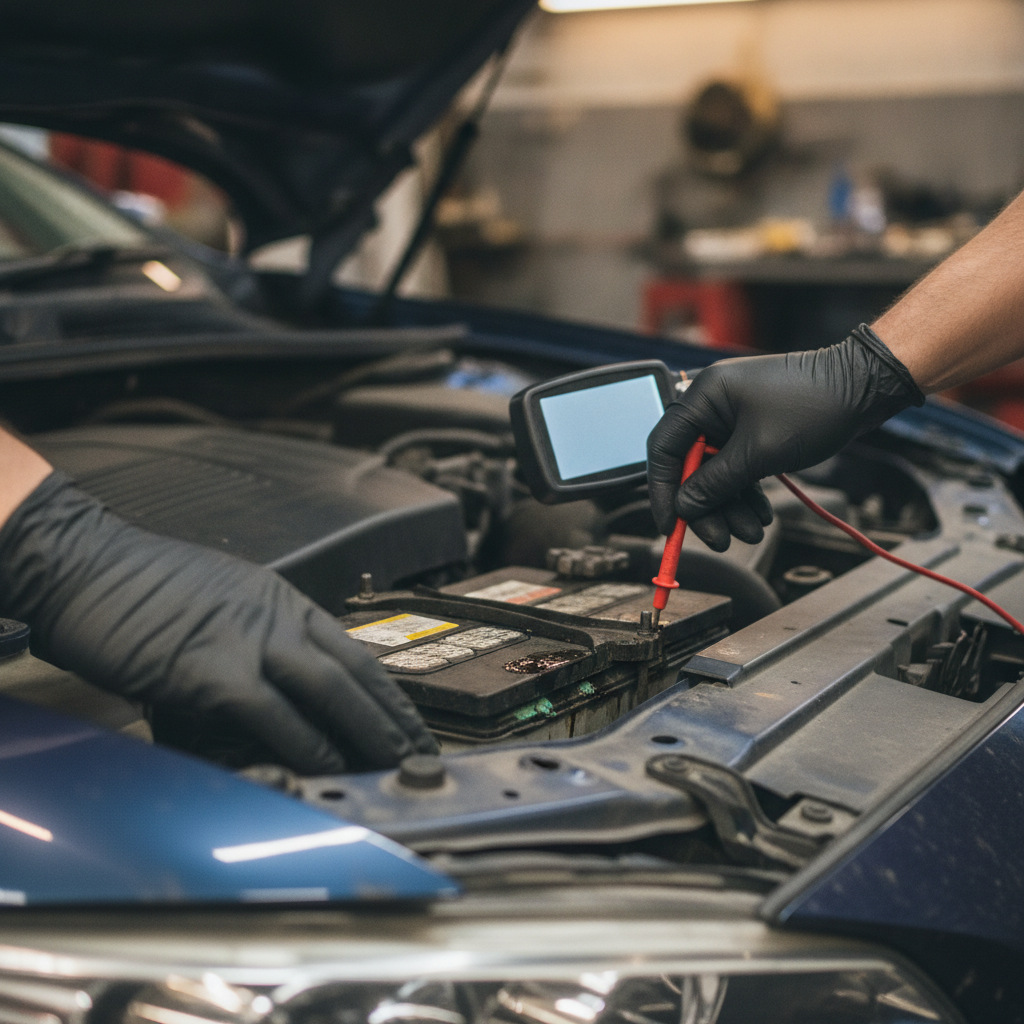
Telling an alternator problem from a battery problem at home takes a $15 multimeter and three minutes. With the engine off, the battery should read 12.4 to 12.7 volts. Start the car. The reading should jump to 13.8 to 14.7 volts within a few seconds. If it does, the alternator is charging. If it stays at 12-something, or it climbs and then drops back down, the alternator is the problem.
Here’s the catch most owners miss: a bad alternator and a bad battery look identical at the surface. Both leave you stranded with a no-start. But the test order matters. If running voltage is below 13, the alternator is bad regardless of how the battery looks. If running voltage is healthy but the battery still won’t hold a charge overnight, the battery is bad. Replace the wrong one and the problem comes back in a week. So:
- Engine off, measure across the battery terminals. Below 12 volts means the battery is depleted.
- Engine running, measure again. Below 13.5 volts means the alternator isn’t charging.
- Turn on headlights, AC, rear defrost, measure again. If voltage drops more than a few tenths, the alternator can’t handle load. That’s a failing alternator even if the no-load test passes.
That last step is the one chain-store testers skip. The bench test pulls the alternator off the car and spins it on a fixture with no real load, so diodes and regulators that fail under heat or load look fine on that test. The load-test version (on the car, with the headlights on) is the one that catches the failing alternator before you replace another battery for nothing.
When the AutoZone Test Passes but the Car Keeps Dying
An alternator that passes the parts-store test but keeps killing the battery is failing intermittently, usually under heat, and the cold no-load bench test can’t see it. This is the single most common scenario I get called out on for a second opinion. Customer takes the alternator off, drives it to the chain store, gets a “tested good” sticker, puts it back on, dies again two days later. The test isn’t lying. It’s just not testing the failure mode.
Two things cause this:
- The voltage regulator fails when hot. Cold, it regulates normally. After 20 minutes of driving in summer, it stops, output drops to 12 volts, and the battery starts feeding the car. The parts-store test runs on a cold alternator for 30 seconds. It’ll pass every time.
- One or two diodes in the rectifier pack have shorted. The remaining diodes carry the load fine at low RPM, no demand, no heat, and the bench test passes. Put load on it and the working diodes overheat and output collapses.
The way to catch it is a load test on the running car, with everything electrical on, after the car has been driven 20 minutes. If voltage drops below 13 under load, the alternator is bad. Doesn’t matter what the chain store sticker says.
What Gets Mistaken for a Bad Alternator
Half the alternators I’ve replaced were actually fine, and the real culprit was somewhere else in the charging circuit. The alternator gets blamed because the symptoms point that way, but if you don’t check these first, you’ll throw money at the wrong part.
- Bad ground strap or corroded battery terminals. A loose or corroded ground reads the same as low alternator output on a multimeter. Clean the terminals and the engine-to-chassis ground strap before you condemn the alternator. Five-minute job, saves you $250.
- Parasitic draw from an interior light or aftermarket stereo. A trunk light that won’t shut off, a dashcam wired direct to battery, a glove-box lamp stuck on. Any of these will drain the battery overnight while the alternator does its job during the day. Looks identical to alternator failure. Test for it by pulling the negative cable and watching for amperage draw with the car off.
- A loose, glazed, or wrong-sized serpentine belt. If the belt is slipping on the alternator pulley, the alternator spins slower than it should and can’t produce rated voltage. Easy visual check: the belt should be tight enough that you can’t twist it more than 90 degrees by hand. The Car Care Council’s maintenance guide lists belt inspection as a routine item that catches alternator-adjacent failures before they cascade.
- The battery itself. Old batteries lose internal capacity. They’ll start the car fine on a Tuesday and fail on a Wednesday. A load test on the battery alone separates this from alternator failure.
- Wiring or fusible link between the alternator and battery. Rare, but the main charging wire can develop high resistance from corrosion. Voltage at the alternator terminal reads normal, voltage at the battery reads low. The alternator is fine. The connection is broken.

How Long Can You Drive With a Failing Alternator?
You can usually drive 30 minutes to an hour on a fully charged battery once the alternator stops charging, but it depends entirely on what’s drawing current. Daytime, no AC, no radio, no wipers, you might get an hour. Night with headlights on, defrost running, heated seats, wipers going, twenty minutes if you’re lucky. Once the battery runs down to about 9 volts, the ECU can’t fire the injectors and the engine quits.
The order things shut off in is a useful warning:
- Power windows get slow.
- Radio cuts out or starts resetting.
- Dash gauges flicker.
- Headlights go from dim to barely visible.
- Engine starts running rough.
- Engine stalls.
If you’re past step 3, get to a parking lot. Don’t try to make it home. A car that stalls at 45 mph in traffic with no power steering and no power brakes is the actual danger here, more than the cost of a tow.
FAQs
Will a bad alternator kill a brand-new battery?
A bad alternator will absolutely kill a brand-new battery, sometimes in less than a week. The alternator is what keeps the battery charged while you drive, and when it can’t, the battery does all the work. Repeated deep discharges damage the lead plates inside the battery permanently, and even a fresh battery can be ruined in 5 to 10 cycles of running down to nothing. This is why anyone who’s been told “you just need a new battery” twice in six months is almost certainly dealing with a failed charging system, not a bad battery.
How much does it cost to replace an alternator?
A typical alternator replacement runs $350 to $900 total. Parts in the $150 to $500 range, labor between $100 and $300 depending on access. Some V6 engines bury the alternator behind the front engine cover, which can push labor to four hours. On most four-cylinder sedans, the job takes 45 minutes to 90 minutes and is doable in your driveway with hand tools. Detroit Axle carries direct-fit alternators for most makes and models, often with a 10-year warranty that beats anything the chain stores offer.
How long do alternators last?
Most alternators last between 80,000 and 150,000 miles, with about seven years being the average lifespan. Highway-heavy driving tends to extend that. Alternators wear faster on cars that idle a lot or run high accessory loads (trucks with snow plows, vehicles with aftermarket audio, work vans). If yours is past 100,000 miles and you’re seeing any of the symptoms above, replacement is cheaper than the cascade of dead batteries and tow bills.
Can I drive home with the battery light on?
You can usually drive home with the battery light on if home is less than 30 minutes away and it’s daytime, but turn off every accessory you don’t need. Kill the AC, the radio, the rear defrost. Don’t drive at night with the light on, because headlights will eat the battery in 15 minutes. And don’t shut the engine off if you can avoid it; the battery may not have enough left to crank it back over. A tow is cheaper than a stall in traffic.
Why did my replacement alternator fail right away?
A replacement alternator failing within weeks usually means one of three things: the replacement part was a rebuilt unit with weak diodes (chain-store rebuilds have a roughly one-in-five failure rate in the first year, in my experience), the underlying problem wasn’t the alternator at all (bad ground, parasitic draw, loose belt), or the battery was already damaged and overworked the new alternator from day one. Always have the battery load-tested when you replace the alternator, and check the ground straps. A new alternator on top of unsolved root cause will fail again on the same schedule as the first one.