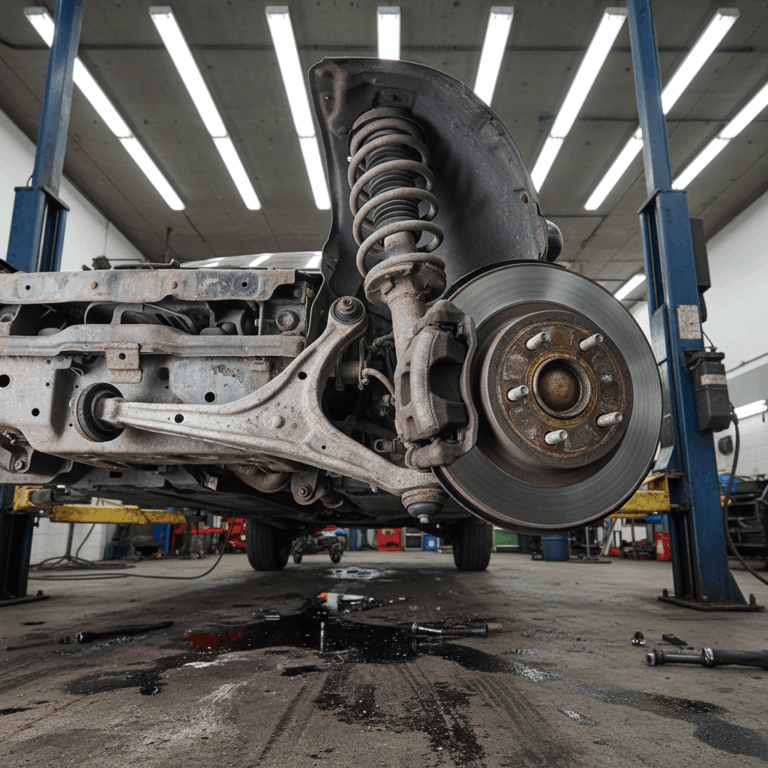
The lower control arm is one of those parts drivers only learn about after something goes wrong. It’s hiding under the front of the car doing three jobs at once, and when it wears out you feel it in the steering, the tires, and the ride. Here’s what a car’s lower control arm actually does, how it’s built, and why it’s the single suspension part most worth understanding if you plan to keep your car past 100,000 miles.
Key Points to Review
- The lower control arm connects the chassis to the steering knuckle at the bottom of the wheel, keeping the wheel locked in the correct position.
- Three jobs: side-to-side wheel location, vertical pivoting for bumps, and a pivot point for steering.
- Two pivot points per arm: bushings at the chassis end, a ball joint at the knuckle end. Both wear out over time.
- Every car has at least one pair on the front. Rear lower control arms are common on independent-rear-suspension cars too.
- When it fails: loose steering, clunking, uneven tire wear, alignment that won’t hold.
- Lifespan is typically 90,000 to 150,000 miles, shorter in salt-belt or gravel-road conditions.
What Is a Lower Control Arm?
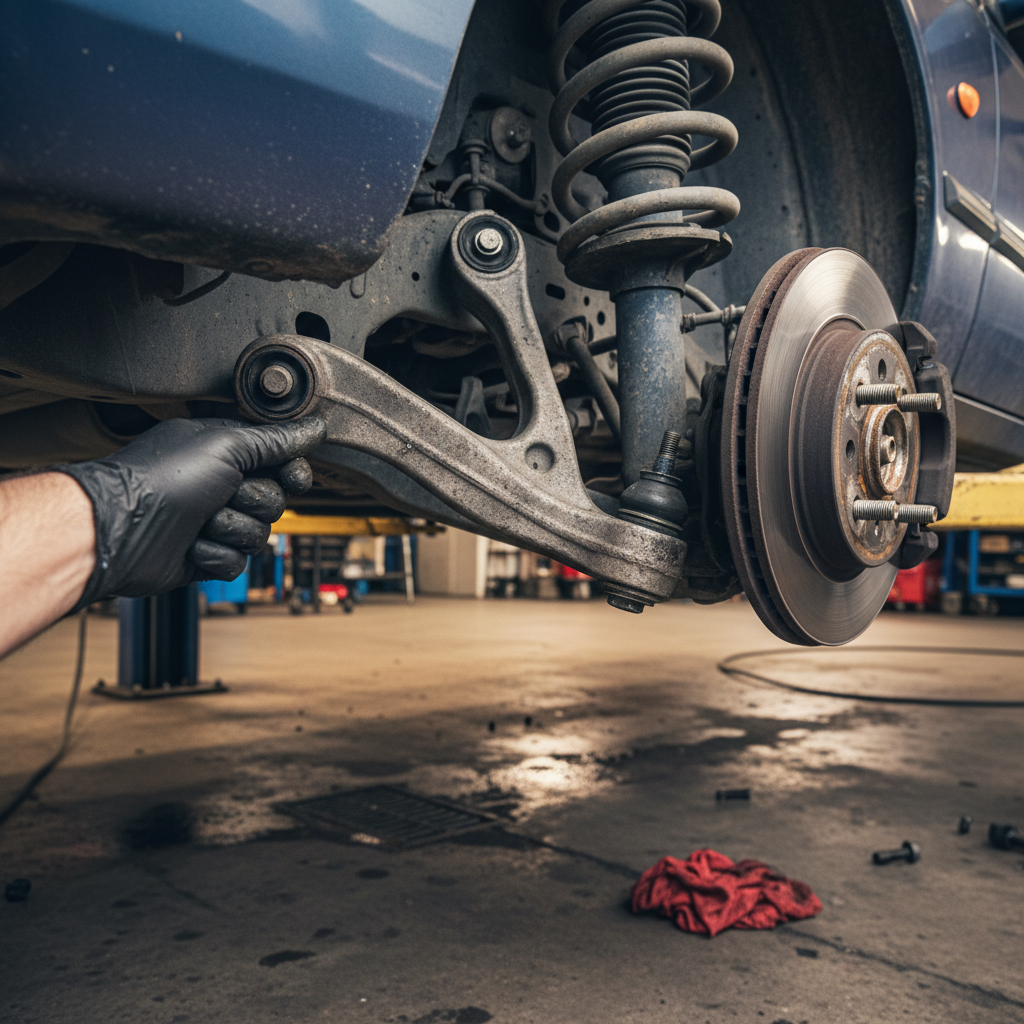
A lower control arm is a metal or aluminum suspension arm that connects the bottom of the wheel assembly to the car’s chassis. Looking at it from below, it’s usually a triangle or an A-shape (that’s where the nickname “A-arm” comes from), with two mounting points on the inner side that attach to the frame and one mounting point on the outer side that attaches to the steering knuckle.
The arm itself is structural. It holds the wheel in the correct position side-to-side and resists the forces of braking, cornering, and accelerating. Because the arm sits inside the vehicle’s safety path, NHTSA’s vehicle safety resources covers the broader suspension and wheel component category that affects handling and crashworthiness. Without it, the wheel would fold outward the moment you accelerated, or inward the moment you braked. It’s one of the few parts on a car whose failure is not just inconvenient. It’s unsafe.
How the Lower Control Arm Works
The arm works through two hinges. The inner end, where it meets the chassis, uses rubber or polyurethane bushings that let the arm pivot up and down as the suspension cycles. The outer end, where it meets the knuckle, uses a ball joint that lets the wheel both steer and move vertically at the same time. Every bump, every turn, every brake application routes force through those two pivots.
Here’s the physics. When you hit a pothole, the wheel moves up and the arm rotates up with it, pivoting on the inner bushings. When you turn the steering wheel, the knuckle rotates around the ball joint. Both motions happen constantly while you drive, and both depend on the arm staying rigid while the bushings and ball joint absorb the movement. The arm doesn’t flex. The pivots do.
Main Components
Three parts make up the assembly:
For an annotated lower control arm diagram showing exactly where each part sits, see the full parts breakdown.
- The arm body: stamped steel, forged steel, or forged aluminum depending on the car. Late-model luxury and performance cars use aluminum to save weight. Trucks and older cars use steel.
- The bushings: rubber or polyurethane sleeves pressed into the inner end of the arm. One or two per arm. They’re the sacrificial wear part.
- The ball joint: a ball-and-socket pivot at the outer end of the arm. Either bolted in (serviceable) or riveted in (integrated). Also a wear part, but it usually outlasts the bushings unless the boot tears.
Where It Sits in the Suspension
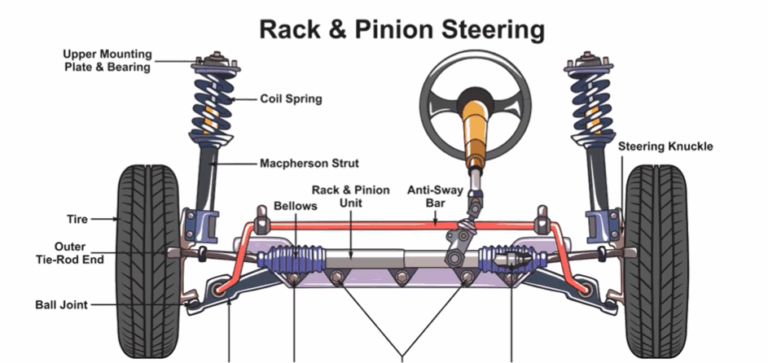
On a MacPherson strut car (most compact and midsize sedans), the lower control arm is the only arm on the bottom of the suspension. The strut handles the vertical load and the upper pivot point. The lower control arm does all the side-to-side work. No upper arm exists.
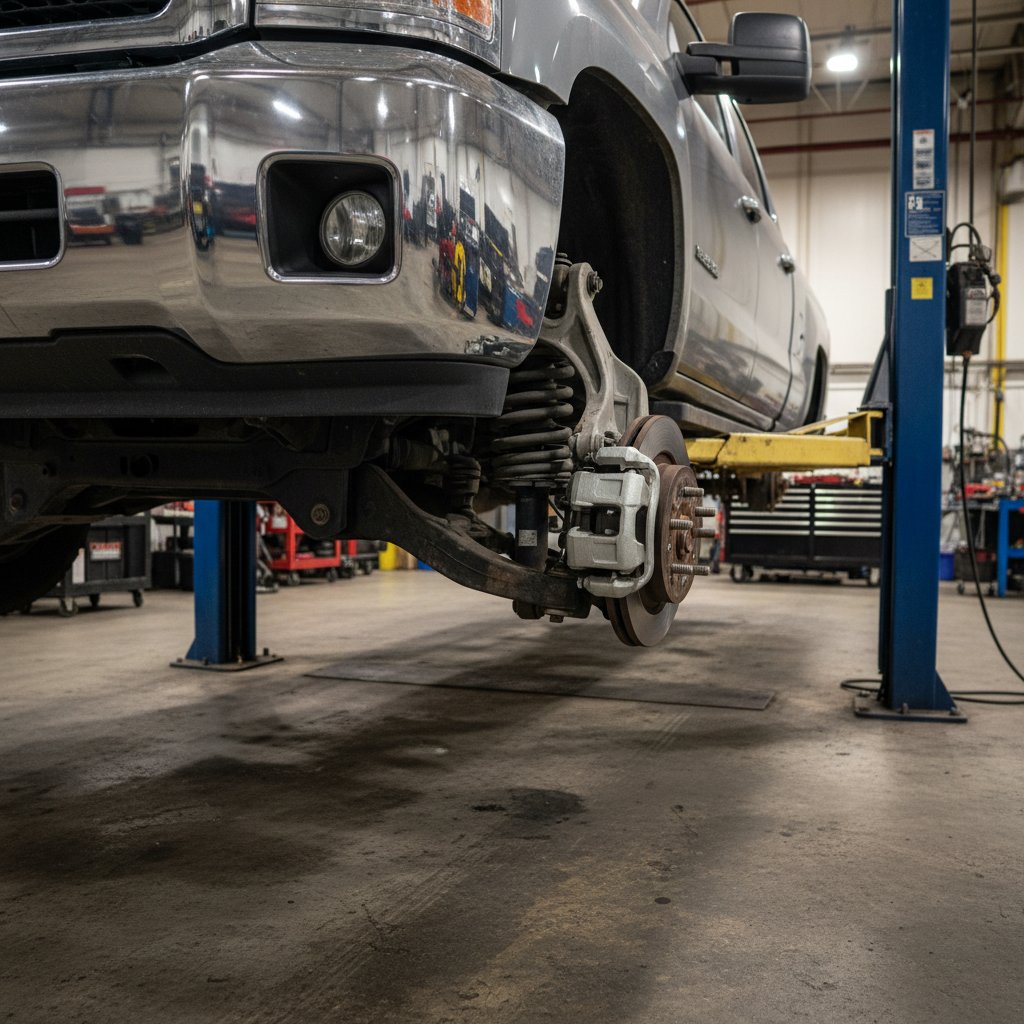
On a short-long arm (SLA) suspension (most trucks, body-on-frame SUVs, some performance sedans), there’s both an upper and a lower control arm. The lower arm is longer and takes more load. The upper arm is shorter and fine-tunes the wheel’s camber through suspension travel. For a side-by-side breakdown, see how all the suspension components work together.
Why the Lower Control Arm Matters
Three things depend on the arm doing its job right. Skip any of them and you’ve got a problem.
Wheel Alignment
The arm’s position sets your wheel’s camber and caster reference points. When the bushings are fresh and the arm is straight, the wheel sits at factory spec and your tires wear evenly. When the bushings soften or the arm bends, the wheel drifts out of spec and the tires get chewed up. AAA’s tire safety and maintenance guide points to alignment drift and suspension wear as two of the leading causes of premature tire replacement. An alignment shop can only compensate so far. If the arm is shifted, the alignment won’t hold.
Steering Response
The ball joint at the outer end is the steering pivot. Every time you turn the wheel, the knuckle rotates around that joint. Play in the joint translates directly to play in the steering. A loose ball joint means the car doesn’t go exactly where you point it, especially at highway speed. Drivers blame the steering rack or tie rods. Often it’s the ball joint.
Safety
The arm is the only thing holding the wheel to the car on the lower side of the suspension. If the ball joint separates, the wheel folds under the car and you drop to the arm. If the arm itself breaks (rare, but it happens on severely rusted cars), the same thing. Either way, you’re steering with three wheels at highway speed. That’s not drama. It’s what happens.
Common Lower Control Arm Problems
Two wear parts, two ways to fail. Here’s what shows up at the shop most often.
- Worn bushings. The #1 failure mode. Rubber hardens and cracks with age and heat. Clunking over bumps, loose steering, alignment that won’t hold. Full bushing cost and symptom breakdown.
- Worn or torn ball joint. The dangerous one. Clunk on turning at low speed, shaky steering at highway speed, visible play when you pry. Full ball joint explainer.
- Bent or damaged arm. Uncommon but possible after a hard pothole or curb strike. Alignment won’t hold and tire wear is uneven.
- Rust. Severe corrosion on stamped-steel arms in salt-belt cars. Replace before it fails.
See the six warning signs of a bad lower control arm for how to diagnose which of those you’re dealing with.
When to Replace a Lower Control Arm
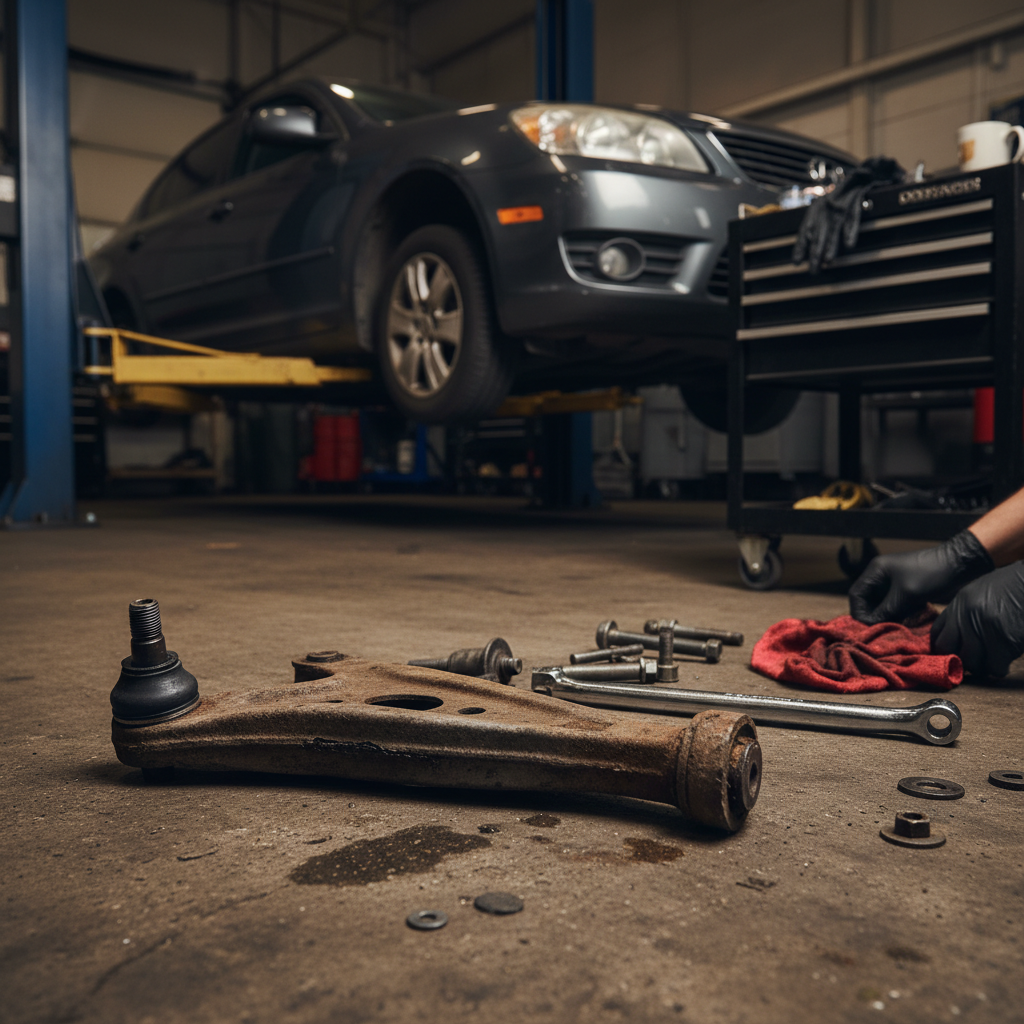
Replace it when the bushing is torn or separated from the sleeve, when the ball joint has perceptible play or a torn boot, when the arm is visibly bent or corroded, or when you’ve got unexplained alignment drift after ruling out other parts. Most cars go through at least one arm replacement between 100,000 and 180,000 miles. Rust-belt cars see it sooner.
Both sides have the same miles. If the driver side is worn, the passenger side is usually within a few thousand miles of failure. Doing both while the car’s on the lift adds maybe 30 to 40% to the labor, not 100%, and you only pay for one alignment. For the full cost picture, see the 2026 lower control arm replacement cost guide.
FAQs
What does a lower control arm do on a car?
A lower control arm on a car connects the chassis to the bottom of the wheel assembly and holds the wheel in its correct position. It does three jobs at once: it locates the wheel side-to-side so the tires wear evenly, it pivots up and down so the suspension can absorb bumps, and it provides the lower pivot point the wheel rotates around when you steer. Without it the wheel has no lower attachment to the car.
How long does a lower control arm last?
A lower control arm typically lasts 90,000 to 150,000 miles on cars driven on decent roads. The arm body itself usually outlasts the car. The bushings and ball joint wear out first. Salt-belt cars and gravel-road vehicles see failures closer to 60,000 to 80,000 miles. Luxury cars with aluminum arms and voided bushings sometimes go the full life of the vehicle.
Can a car still drive with a bad lower control arm?
A car can still drive with a bad lower control arm for a short window, but it’s risky and depends on which part of the arm is failing. A worn bushing is manageable for a week or two at city speeds. A failing ball joint is not. If you’re hearing a sharp clunk on turns, feeling a shimmy at highway speed, or seeing grease on the arm, the ball joint is on its way out and the failure mode is the wheel folding under the car. Park it and get it diagnosed.
What’s the difference between a lower control arm and a strut?
A lower control arm and a strut are two different suspension parts that work together. The strut is the vertical shock-absorbing unit that carries the coil spring and damps vertical motion. The lower control arm is the horizontal arm that locates the wheel side-to-side and pivots up and down with the suspension. They connect at the steering knuckle and both attach to the chassis separately. The strut handles vertical load, the arm handles lateral location.
How much does it cost to replace a lower control arm?
Lower control arm replacement costs $250 to $650 per side at an independent shop in 2026, including parts, labor, and alignment. Compact front-wheel-drive cars sit at the low end. Trucks, performance sedans, and European luxury run higher because of forged aluminum arms and longer labor times. See the full lower control arm replacement cost breakdown for vehicle-specific ranges.