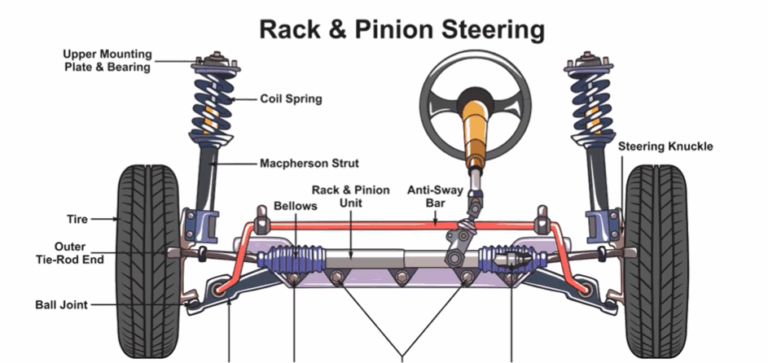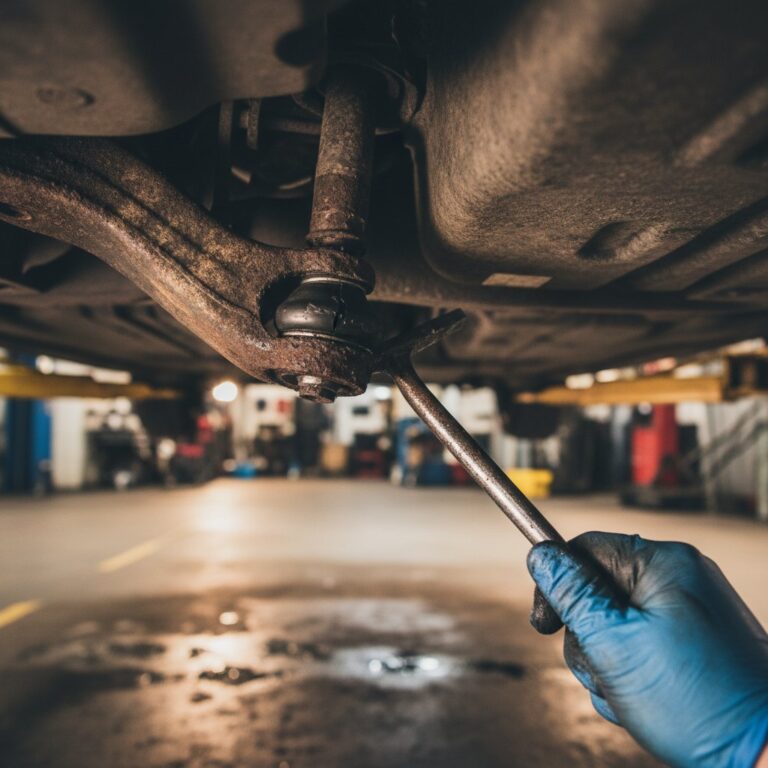
A worn lower control arm rarely announces itself clearly. It starts as a clunk you can almost ignore, or steering that’s just a little off. Quick refresher on the parts of a lower control arm if you need it: the wear lives in the bushings and ball joint, never in the arm body itself. Most people chalk it up to bad roads or old tires. By the time the symptoms are obvious, the ball joint or bushing is usually past the point where you should be driving on it. Here are the six warning signs we see most often at the shop, and what each means about the damage underneath. If you need a refresher on the part itself, see what a lower control arm does.
Key Points to Review
- Clunking over bumps is the #1 tell. Loose bushings or a worn ball joint, either way, the fix isn’t getting cheaper.
- Steering that wanders or pulls shows up on the highway first. Don’t write it off as alignment until you’ve checked the arms.
- Uneven tire wear, especially the inner edge of a front tire, means the arm has let geometry drift.
- Shaky steering wheel at speed that feels worse on braking is a ball joint or bushing play signal, not a rotor issue.
- Alignment that won’t hold after a fresh alignment job is a dead giveaway the arm is done.
- Visible damage (torn bushing rubber, a leaking ball joint boot, or play when you pry) means replace now. Not next month.
Why Lower Control Arm Symptoms Get Missed
Every symptom overlaps with something else. Clunking sounds like a sway bar end link. Pulling feels like alignment. Tire wear gets blamed on “bad tires.” Meanwhile the arm is quietly chewing itself apart under the car, stressing tie rods and sway bar links while it does. By the time the driver finally brings it in, we’re often writing up more than one part.
The early stage doesn’t feel dangerous, either. A bushing can have significant wear before the steering gets squirrely enough to scare anyone. But the ball joint end is the part you can’t gamble with. If it separates at speed, the wheel folds under the car. That’s not drama. That’s what happens.
1. Clunking or Knocking Over Bumps
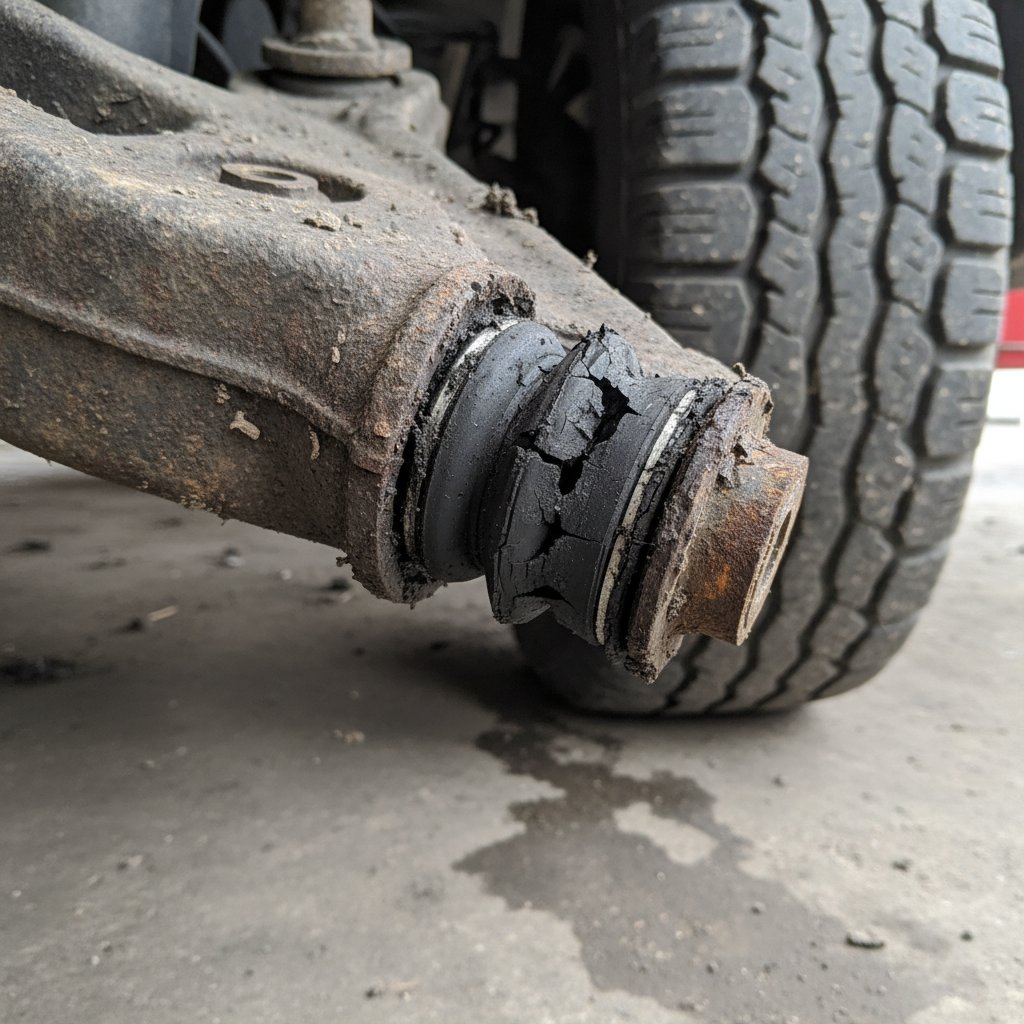
Nine out of ten drivers notice this one first. Hit a pothole, hit a speed bump, hear a sharp clunk from the front. Sometimes one side, sometimes both. The sound is the bushing or ball joint letting the arm move more than it should, metal on metal as the suspension cycles.
Here’s how to tell which end is failing. Clunk on vertical hits (potholes, speed bumps) usually points at the bushing. Clunk when turning the wheel at low speed, like pulling out of a parking spot or making a tight right, that’s the ball joint. Both on the same car is common. Had a Camry last month with both front arms clunking; driver thought it was the struts.
2. Pulling to One Side or Wandering at Highway Speed
The arm sets where the wheel sits in the chassis. When a bushing wears past a point, the wheel shifts its camber and caster under load and the car drifts. The tell is inconsistency. It doesn’t pull the same way on every road. Crown, slight grade, a gust of wind, all of it moves the car more than it should.
Here’s what separates it from a straight alignment problem. A bad alignment pulls steady and predictably. A bad arm feels loose. The wheel doesn’t tug on you. It wanders, and you’re making tiny corrections every few seconds to keep it straight.
3. Uneven or Inner-Edge Tire Wear
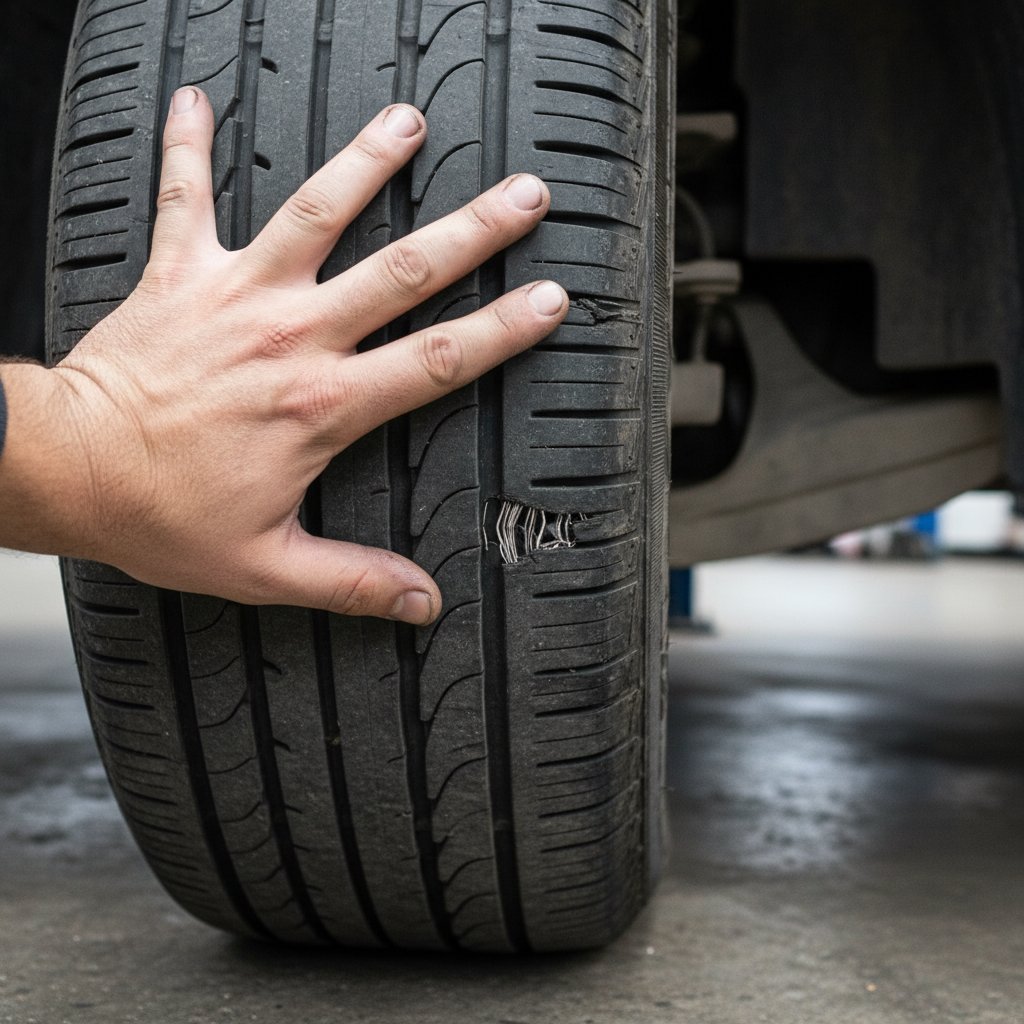
Your front tires are a diagnostic tool. Run your hand across the inside edge. If the tread there is shorter than the outside, the wheel has been sitting at the wrong camber. A worn arm is one of the few parts that causes that drift.
Ugly truth: by the time you feel the wear with your hand, you’ve eaten $100 to $300 of tire life. AAA’s tire safety guide flags inner-edge wear as a classic misalignment signature, and the arm is one of the parts that causes it. We see customers come in for a rotation and leave needing an arm and two new tires. The tire shop catches it before the mechanic does, half the time.
4. Shaky or Vibrating Steering Wheel
A bad arm produces a specific vibration. It shows up at highway speeds, usually 45 to 65 mph, and gets worse under braking, when caliper force loads the already-sloppy suspension. Most drivers blame the rotors. They cut the rotors, rebalance the tires, and the shake is still there. That’s your tell.
The mechanism is simple. A loose ball joint or worn bushing lets the wheel move a few millimeters more than it should. At highway speed, a few millimeters becomes a visible shimmy. Before you spend $400 on rotors that aren’t the problem, have someone grab the tire at 12 and 6 and rock it. Play there points at the ball joint. Play at the inner end points at the bushing.
5. Alignment That Won’t Hold
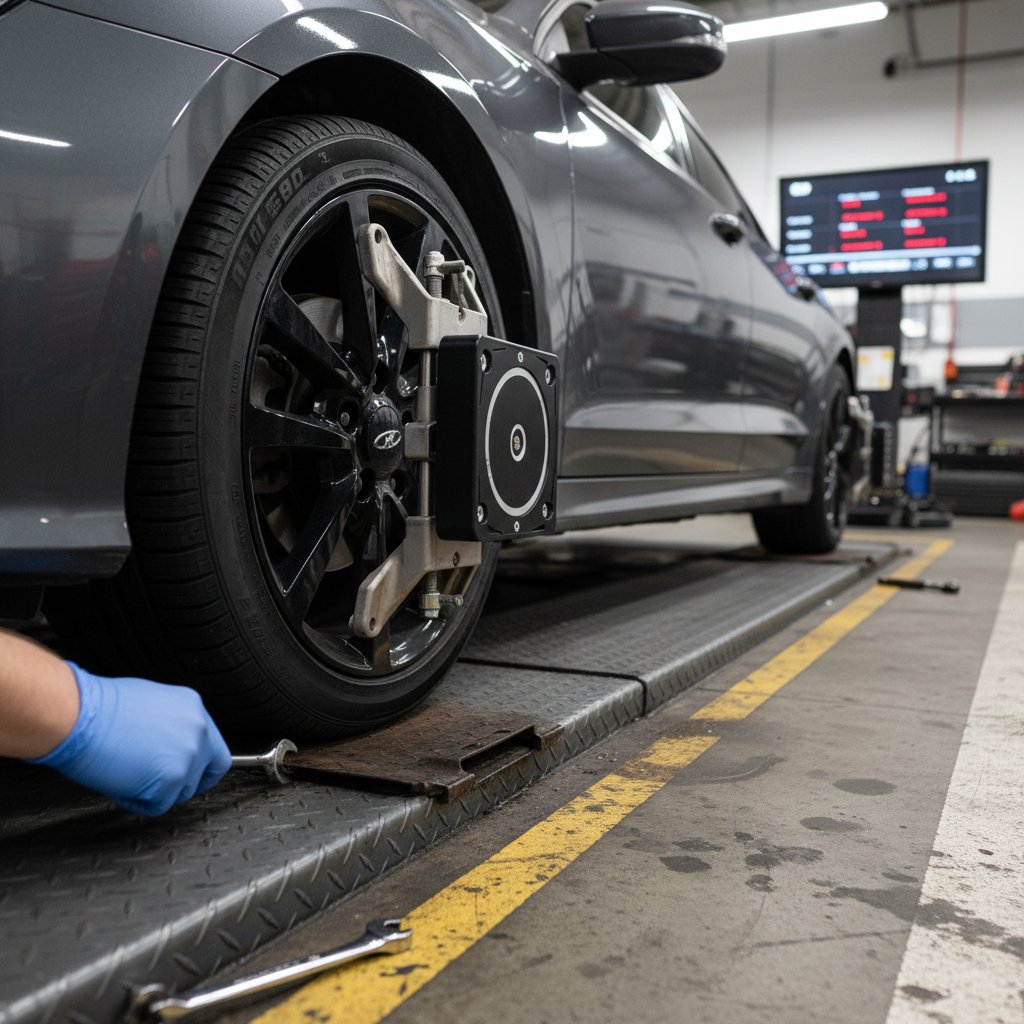
This one is for anyone who just paid for an alignment and finds the steering wheel off-center three weeks later. A worn arm moves enough that a fresh alignment can’t lock in. Straight for a few hundred miles, then drifting as the bushing keeps moving. The shop didn’t mess up. The arm won’t hold spec.
If your alignment didn’t stick, ask the shop to check the front suspension components before you pay for another one. Pinning down the arm first saves you $125 and 4,000 miles of tire wear. The Car Care Council rates annual alignment checks as the best way to maximize tire life, but that only works if the arm can hold spec.
6. Visible Damage on Inspection
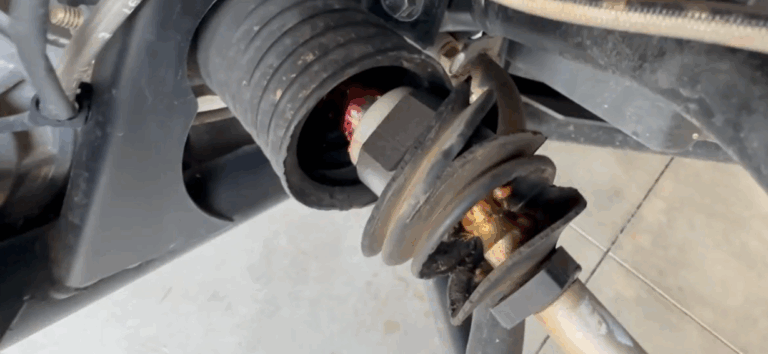
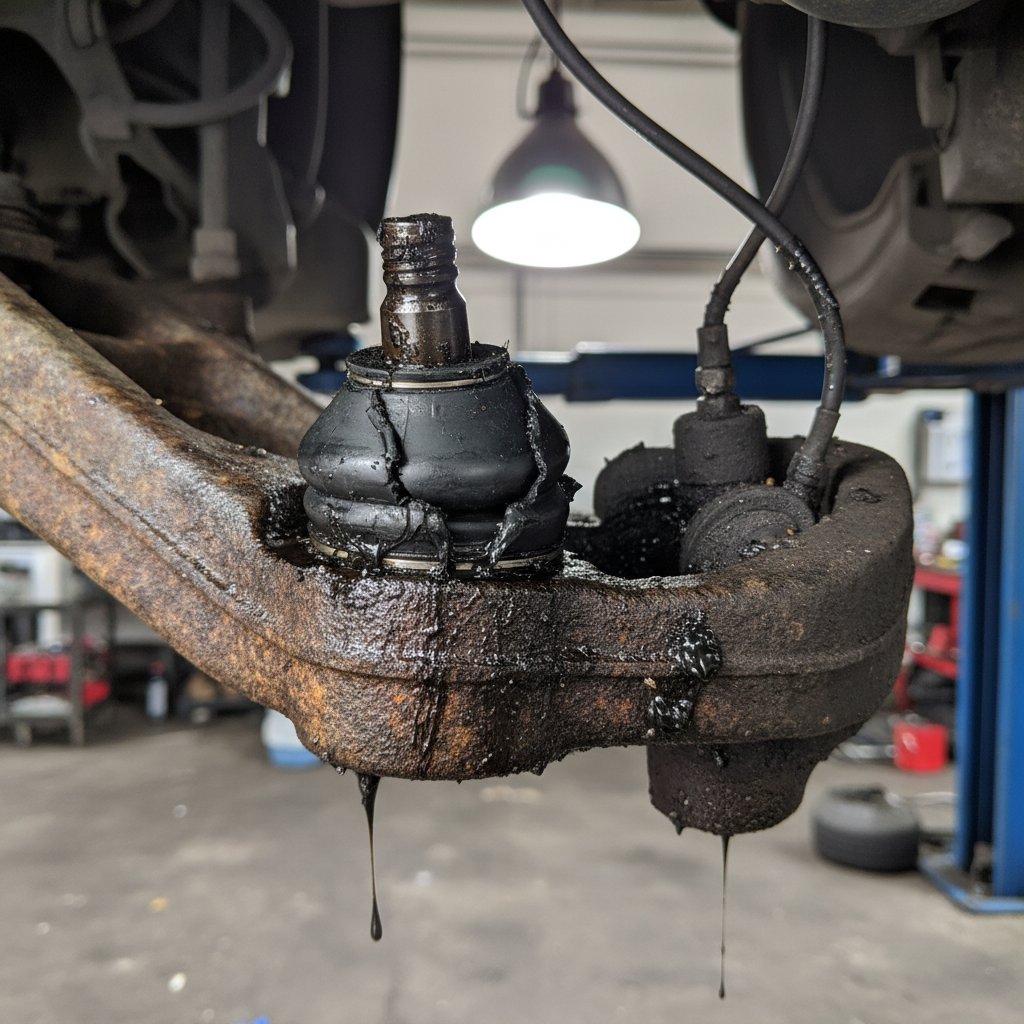
Sometimes the arm tells you directly. Car on jack stands, wheel off. Look at the bushings at the inner end. Cracked rubber, separation where the rubber meets the metal sleeve, or a bushing squashed visibly to one side, any of those mean the arm is done. Then look at the ball joint boot on the outer end. A torn boot means grease is out and dirt is in. Once that happens, the joint has weeks to months, not years.
Quickest hands-on check: pry bar under the tire, lift. Watch the ball joint. If the stud moves in its socket at all, replace the arm, or the ball joint if yours is serviceable. Any perceptible play and you’re on borrowed time.
What Gets Mistaken for a Bad Control Arm
Before you throw parts at this, rule these out. They mimic the symptoms:
- Sway bar end links, the #1 false alarm for clunking. End links cost $30; disconnect one and drive slowly. If the clunk goes, it wasn’t the arm.
- Strut mount. A collapsed top makes a thunk like a bushing clunk, but usually only at full suspension travel.
- Tie rod ends. These cause wander and uneven tire wear too. Difference: tie rod play shows in the 9-and-3 tire rock, not 12-and-6.
- Wheel bearing. A hum or rumble that changes when you turn, no clunk.
A decent tech sorts this in fifteen minutes hands-on. If you have a shop quote for a control arm and you’re unsure, spend $50 on a diagnostic at a second shop. We’ve seen people replace good arms because the actual problem was a $30 end link.
When to Act: Mild, Moderate, Severe
Not every clunk means drop everything. But some do. Here’s how we stage it at the counter:
Mild, schedule within the month. Occasional clunk on harsh hits, alignment still holds, no tire wear, no shimmy. Bushings are aging but nothing’s about to break. Budget a control arm replacement at $400 to $700 per side at an independent shop. If you’re handling it yourself, here’s the step-by-step DIY guide.
Moderate, within two weeks. Consistent clunking, highway wander, uneven tire wear starting. The bushing is past service life and the ball joint is probably going too. Driving like this eats your tires and stresses everything around it.
Severe, park it. Clunk on every turn, visible ball joint play with a pry bar, torn boot with grease on the arm, alignment won’t hold for a week. DO NOT drive on the highway. The failure mode is the ball joint separating. Wheel folds under, car drops to the arm, you steer into whatever’s next to you. Tow it or do the job this weekend.
FAQs
Can I drive with bad lower control arm symptoms?
Driving with bad lower control arm symptoms is risky and depends on which symptom you have. Bushing wear with mild clunking is manageable for a week or two of careful driving. Ball joint play, torn boots, or visible separation is a different story. The joint can fail completely, and when it does the wheel folds under the car at speed. If the clunk is sharp, steering wanders at highway speed, or you see grease on the arm, don’t put the car on the freeway.
What does a bad lower control arm sound like?
A bad lower control arm usually sounds like a sharp clunk from the front suspension, loudest over potholes and speed bumps. A worn bushing makes a duller thud on vertical hits. A worn ball joint is sharper and more metallic, usually on turning or loading the suspension. A hum or rumble isn’t a control arm. That’s almost always a wheel bearing.
How do I know if my control arm bushings are bad?
Bad control arm bushings usually show up as three things together: clunking on rough roads, steering that feels loose at highway speed, and an alignment that won’t hold spec. Visual check: raise the car and look at the rubber at the inner end of the arm. Cracked, torn, or squashed off-center means it’s done. If the rubber looks clean and round, the ball joint end is more likely the issue.
Can bad control arms cause bad alignment?
Bad control arms can absolutely cause bad alignment, and they’re one of the few parts that can ruin a fresh alignment within a few hundred miles. The arm holds the wheel’s camber and caster reference points. When the bushing wears or the ball joint has play, the wheel drifts out of spec under load and the car pulls or wanders. If your alignment didn’t hold, check the arms before paying for another one.
How long does a lower control arm last?
A lower control arm typically lasts 90,000 to 150,000 miles on cars driven on decent roads. Salt-belt vehicles and gravel-road cars see failures closer to 60,000 to 80,000 miles. The bushings don’t last against that abuse. I’ve seen aluminum-arm luxury cars hit 180,000 without a twitch. For the full breakdown on mileage benchmarks, what shortens the life, and when you can wait vs. when you can’t, see how long lower control arms last. If you’re past 90K and any of the six symptoms above are showing up, the arm is the first thing to inspect.