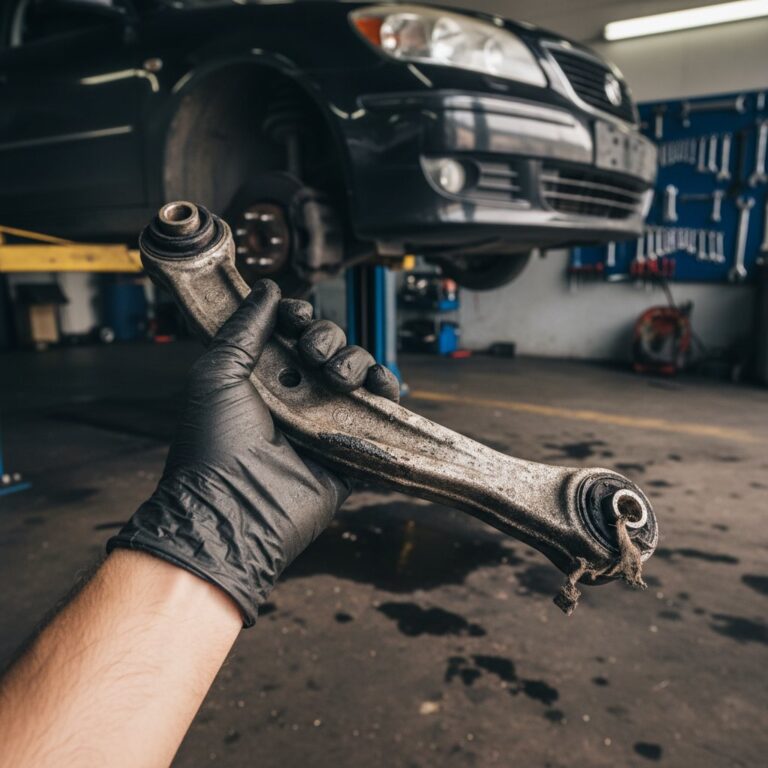
If your car’s clunking over potholes or pulling to one side, a worn lower control arm is usually suspect number one. The bill is less scary than a strut or rack job, but less scary doesn’t mean cheap. And the online quotes are all over the place. I’ve seen the same repair get quoted at $220 on one site and $3,700 on another. Here’s what a lower control arm replacement actually costs in 2026, the way I’d walk you through it at the counter.
Key Points to Review
Replacing one lower control arm typically runs $250 to $650 total. The part itself is $60 to $250. Replacing just the bushing on a serviceable arm is cheaper if your design allows it.
Replacing both in one visit: $450 to $1,100. Almost always the right call if one side is worn.
Alignment after the job: $100 to $150. Not optional. Skip it and you’ll eat your front tires.
Labor: 1.5 to 3.0 hours per side, or $150 to $400 depending on shop rate and how rusted the bolts are.
Quality aftermarket arms from a real supplier run 40 to 60% less than dealer pricing. No compromise on fit or life.
Trucks and performance sedans cost more. Compact FWD cars are the cheapest job on the rack.
Average Lower Control Arm Replacement Cost
One side on a mainstream car or crossover in 2026 averages $400 to $550 all-in. That’s a mid-tier aftermarket part, about two hours of labor at $130 to $160/hr, and the alignment after. Both sides at once? $700 to $1,000 on average, because labor overlaps and you only pay for one alignment.
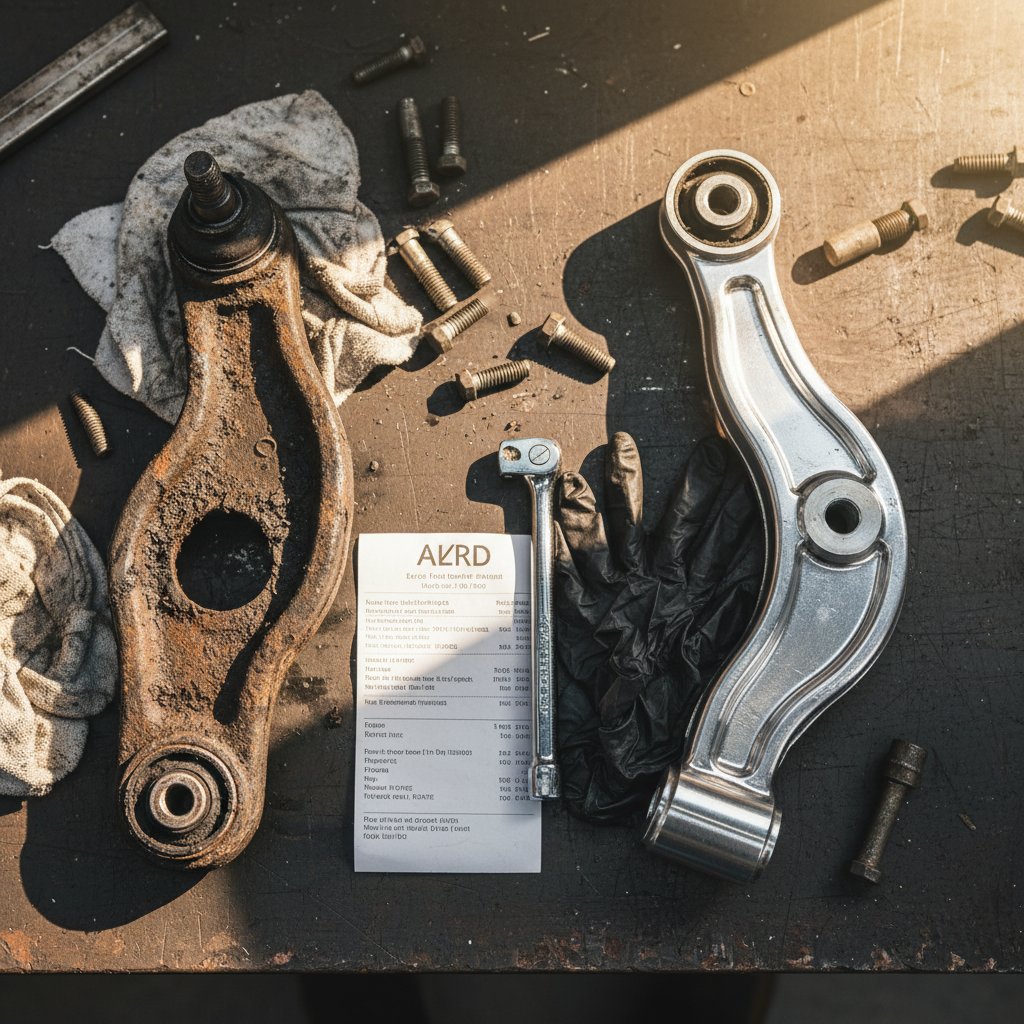
The part is where the biggest swing happens. A plain stamped-steel arm for a Civic or Corolla is $60 to $90. Now go look at a forged aluminum arm with an integrated ball joint for a late-model F-150 or a 3-Series. $180 to $350 per side, and that’s the aftermarket price. Dealer parts sit at roughly double.
Labor’s mostly geography. A shop in rural Ohio might bill 1.5 hours at $110/hr. The same job in Boston or LA? 2.5 hours at $175/hr. Higher rate, plus coastal rust means more penetrating oil and more broken bolts. Rusted suspension hardware is one of the conditions the Car Care Council’s maintenance guide cites for more frequent undercarriage inspections in salt-belt regions. Had one come in last fall where a rusted pinch bolt added a full hour by itself. We ended up cutting it out with a Sawzall.
What Drives the Cost
The quote you get depends on five things that shops don’t always spell out. If you know which ones apply to your car, you can predict where the number lands before you call.
Vehicle Type and Suspension Design
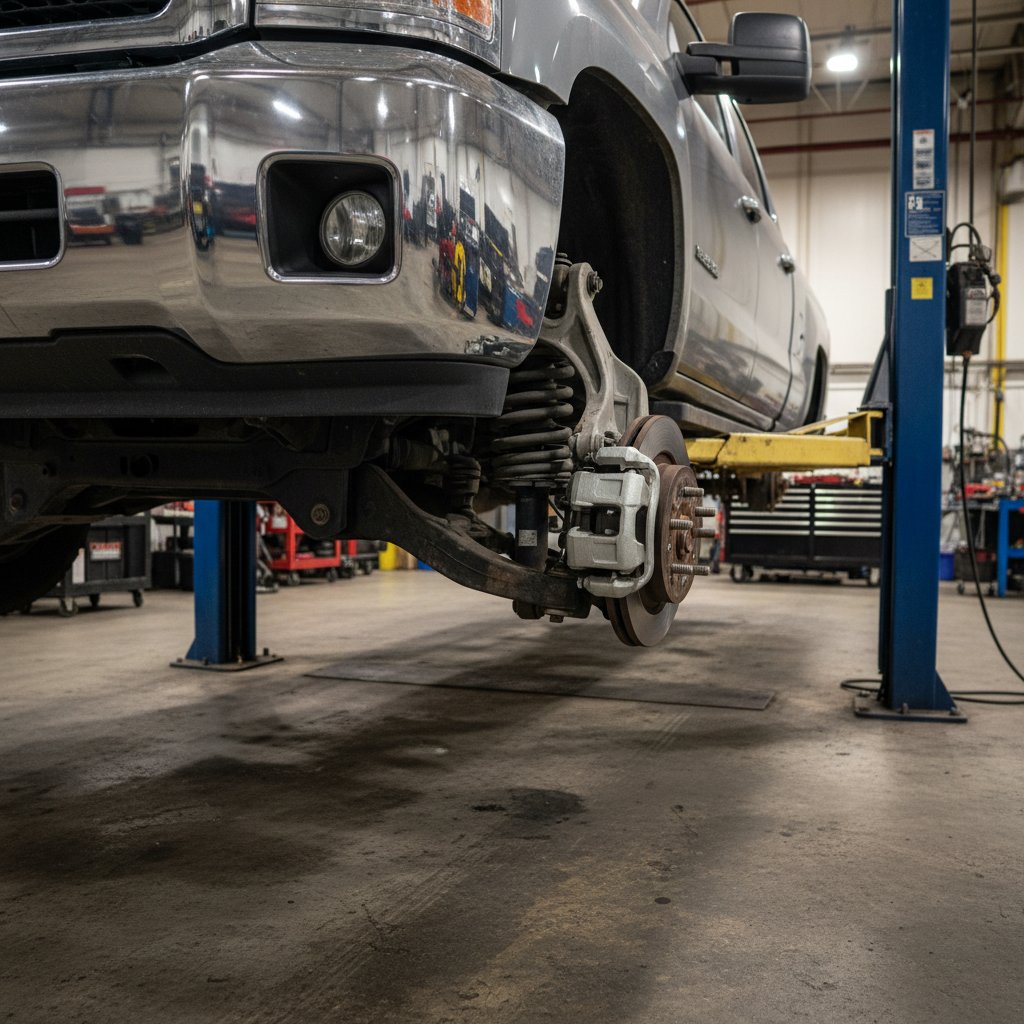
Compact FWD cars with MacPherson strut setups are the easy jobs. Three bolts per arm, maybe an hour of actual wrench time. Pickups and body-on-frame SUVs run a short-long arm (SLA) setup with separate upper and lower arms, sometimes with torsion bars or leaf-spring interaction (a quick primer on car suspension components if you want the full picture). More parts come apart. A truck runs 30 to 60% longer per side than a Civic. F-150s with the torsion setup are a whole afternoon.
Part Quality: OEM vs. Aftermarket vs. Economy
Three tiers, and they’re not equal. Dealer OEM is built to spec and costs the most. Mid-tier aftermarket (brands manufacturing to OE specs and selling direct) costs 40 to 60% less, and it’s what most independent shops actually install. Then there’s economy. The $22 arms you see on overseas marketplaces are garbage. I’ve pulled them off cars with under 25,000 miles on them where the bushing had already separated from the metal sleeve. Don’t buy those. Ever. Control arm construction and fatigue testing tie back to engineering standards maintained by SAE International, which is why a cheap unbranded arm can look identical to a real OE-spec part but fail years earlier.
One Side or Both
If the driver side is worn, the passenger side has seen the same miles, the same potholes, and the same salt. It’s usually within a few thousand miles of failure itself. Doing both sides adds maybe 30 to 40% to the labor, not 100%, because the car’s already on the lift and the alignment only happens once. If a shop quotes you two full-price sides, ask why. That’s a conversation, not a deal-breaker. But you should have it.
Alignment
Any time you pop a lower control arm loose, the wheel’s camber and caster reference points shift. A four-wheel alignment is $100 to $150 at an independent shop, $150 to $200 at a dealer. The number of people who skip this step is ridiculous. I’ve seen Civics come back in 8,000 miles with the inner edges of the tires wire-cord-exposed. A $125 alignment protects a $600 set of tires. It’s not an upsell. It’s part of the job.
Integrated vs. Serviceable Ball Joint
Some arms have a ball joint pressed in that a shop can replace separately. Others are sealed. When the joint goes, the whole arm goes. The key detail: on sealed designs, the ball joint almost always fails before the bushings do. So you end up replacing the whole arm way sooner than the bushings would’ve made you. For a deeper dive on how the joint fails and when to replace just the joint, see how the lower control arm ball joint works. And if you’re not sure whether yours is actually due yet, see how long lower control arms last for the mileage benchmarks and the wait-vs-replace decision.
Cost by Vehicle Class
Quotes run wildly different by vehicle. These are 2026 ranges for a single lower control arm (parts, labor, and alignment) at an independent shop using a quality aftermarket part.
Compact FWD sedan (Civic, Corolla, Sentra, Cruze): $275 to $475
Midsize sedan or crossover (Camry, Accord, RAV4, CR-V): $375 to $600
Full-size sedan (Impala, Charger, 300): $425 to $700
Half-ton truck or SUV (F-150, Silverado, Tahoe, Tundra): $500 to $900
European luxury (3-Series, A4, C-Class, X5): $650 to $1,200. Forged aluminum arms and tight labor times drive this.
Heavy-duty truck (F-250, Silverado 2500, Ram 2500): $550 to $1,000, and the hardware is heavier
Both sides adds about 60 to 70% to the single-side number, not double. Example: one side on a RAV4 at $500 usually means both sides lands at $800 to $850. Not $1,000.
How to Save on This Repair
The part is where you save money. Labor is where the bill climbs, so if you’ve got the tools and an afternoon, here’s how to replace a lower control arm start to finish. Dealer-counter pricing on a control arm runs 2 to 3x what an OE-spec aftermarket arm costs shipped to your door. As long as you’re buying from a supplier with real warranty coverage and solid fit data, you give up nothing. Detroit Axle carries lower control arm assemblies for most domestic and import platforms with a 10-year warranty. That’s what a lot of independent shops install when the customer brings the part.
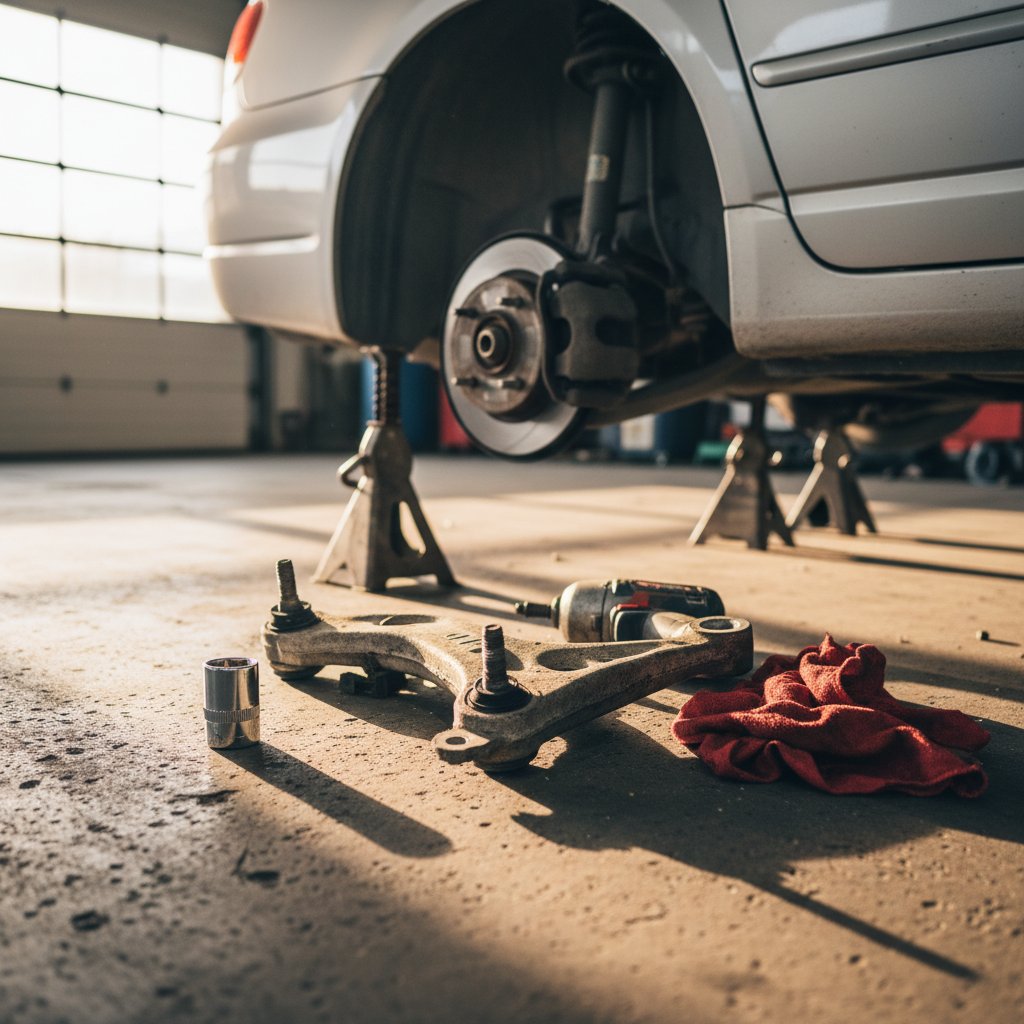
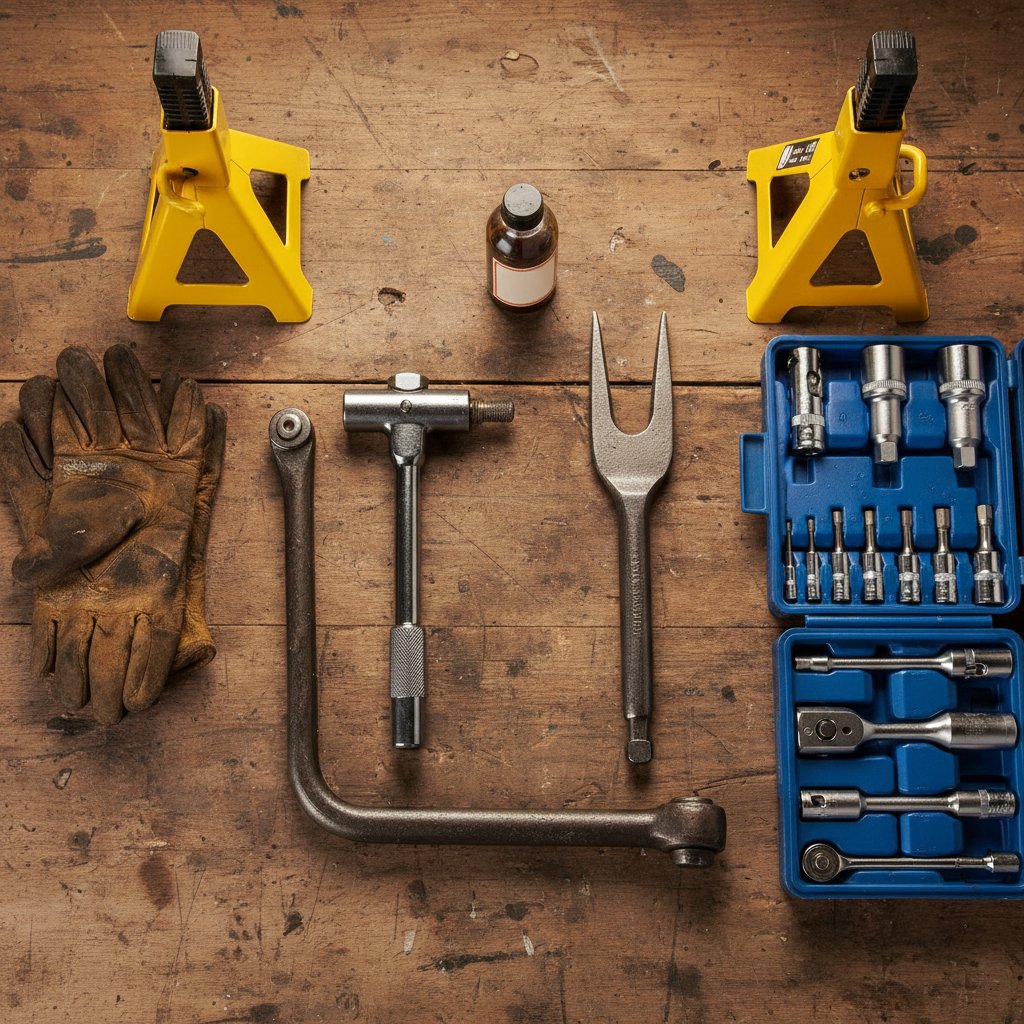
Handy with tools? A lower control arm on a compact FWD car is intermediate DIY. You need a jack, jack stands (NEVER depend on a jack alone), a ball joint separator, a torque wrench that goes to at least 150 ft-lbs, and patience with rusty bolts. Check the lower control arm bolt torque specs before you final-tighten anything. Getting that wrong is the most common reason a freshly-installed arm fails early. Budget 2 to 4 hours per side your first time, then a separate trip for the alignment. Trucks, torsion-bar setups, and anything with a pressed-in ball joint that needs a shop press? That’s shop work. I’ve watched too many driveway jobs turn into a tow bill.
One thing worth checking before you commit to a whole new arm: if your design has a serviceable ball joint and only the joint is bad, you can replace just the joint. A shop will press a new one in for $40 to $80 in labor. Doesn’t work on sealed arms, but where it’s an option, it’s real money saved. Same goes for bushings on serviceable arms. See the bushing replacement cost breakdown for when that’s the right call.
FAQs
Can I drive with a bad lower control arm?
Driving with a bad lower control arm is risky and should be limited to a short trip to the shop. A failing control arm bushing gives you loose steering, clunking over bumps, and uneven tire wear. Those are manageable for a few days. A failing ball joint is the dangerous one: if it separates, the wheel folds under the car at speed. If you’re hearing a sharp clunk on turns or feeling a shimmy in the wheel, don’t put it on the highway.
Do I need to replace both lower control arms at the same time?
Replacing both lower control arms at the same time isn’t technically required, but it’s usually the smart move. Both sides have the same miles, the same potholes, the same salt exposure, the same bushing wear. I see this all the time. Customer replaces one side, drives 4,000 miles, comes back for the other. The labor savings from doing both at once would’ve paid for the second part. If your quote is for one side, ask the shop what the other side looks like before you decide.
How long does a lower control arm last?
A lower control arm typically lasts 90,000 to 150,000 miles on a car driven on decent roads. The bushings are the weak link. Rubber hardens and cracks with age and heat. Rust-belt cars and anything that lives on gravel roads can see failures closer to 60,000 to 80,000 miles. Meanwhile I’ve seen luxury cars with aluminum arms and voided bushings go the full life of the vehicle without a twitch.
Is a lower control arm replacement worth doing yourself?
A lower control arm replacement is worth doing yourself if you have the tools, a flat workspace, and some patience, but only on the right car. Compact FWD cars with three-bolt arms and serviceable ball joints are realistic. Trucks, torsion-bar setups, and cars where the ball joint needs a shop press to install? Not realistic. Factor in the alignment you’ll still have to pay for afterward.
Why is the alignment so important after control arm replacement?
An alignment after control arm replacement is important because the arm controls where the wheel sits in relation to the chassis. Even a fresh arm installed with factory bolts can shift camber by a degree or more. That’s enough to chew the inside edges off your front tires in a few thousand miles. A $125 alignment protects a $600 to $1,200 set of tires. It’s not an upsell. It’s part of the job.
All Content published on this website is provided for general educational and informational purposes only. The Content is not a substitute for consultation with a licensed and qualified automotive technician who can evaluate your specific vehicle, circumstances, and needs. Please read our Terms and Conditions for more information.
The rack and pinion steering system is the most common steering setup found in modern passenger vehicles. It transforms the steering wheel’s rotational movement into the side-to-side motion required to turn the front wheels. It can be simpler to diagnose…
Rack and pinion steering systems play a major role in how your vehicle handles, responds to steering input, and stays controlled on the road. When problems develop, many drivers face the same question: should you repair the rack and pinion…
A failing rack and pinion can quickly turn a smooth-driving vehicle into one that feels unstable, noisy, and difficult to control. Ignoring early warning indicators can result in costly repairs, uneven tire wear, and major safety issues because the rack…