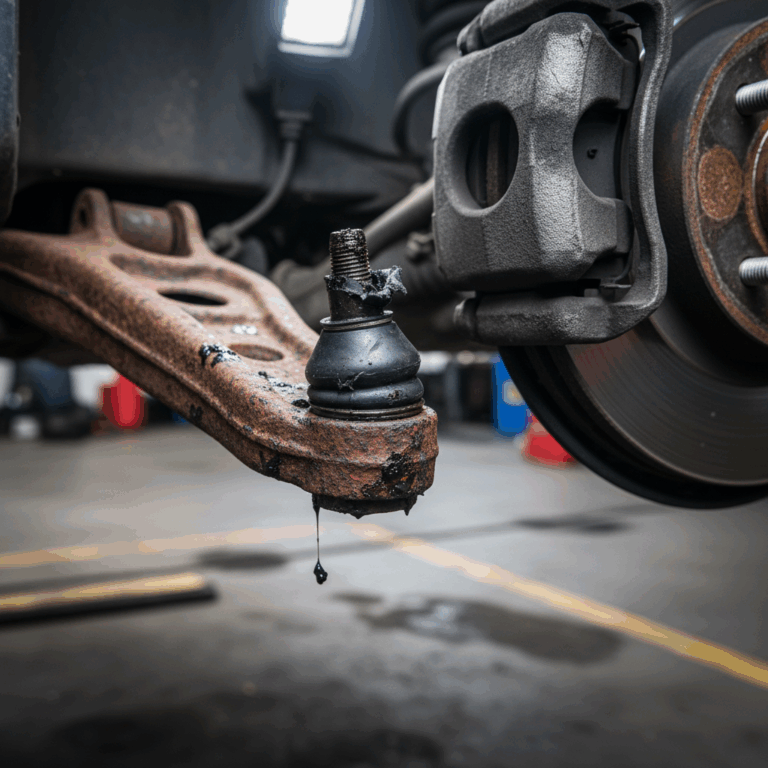
The ball joint is the part of the lower control arm you can’t ignore. The bushing at the other end of the arm can be worn for months before you feel it. The ball joint is the one that fails suddenly, folds the wheel under the car at speed, Ball joint separation has driven manufacturer recalls catalogued by NHTSA’s recalls database, which is why shops do not green-light further driving once play is confirmed. and ends the trip on a flatbed. Here’s what a lower control arm ball joint actually does, how it fails, and when you’re looking at a $60 fix vs. a new control arm.
Key Points to Review
- The lower ball joint is the outer pivot on your control arm. It lets the wheel steer and move vertically while the arm stays put.
- Serviceable ball joint: $40 to $80 parts, $80 to $150 labor. A shop presses the old joint out and the new one in.
- Integrated (sealed) ball joint: the whole control arm has to be replaced. $250 to $650 per side all-in. Doing it yourself? Here’s the full step-by-step lower control arm replacement guide.
- The key failure symptom is a clunk when turning at low speed, plus visible play when you pry the tire up.
- A torn boot means the grease is out and dirt is in. Once that happens, the joint has weeks to months, not years.
- Do NOT drive on a ball joint you can’t trust. Separation at highway speed is a tow-truck event at best.
What Is the Lower Control Arm Ball Joint?
The lower control arm ball joint is the pivoting connection at the outer end of the arm, where the arm meets the steering knuckle. Think of it like the ball-and-socket joint in your hip. The “ball” is a steel stud seated in a socket packed with grease, sealed by a rubber boot. The arm controls side-to-side motion. The joint lets the knuckle rotate for steering and move up and down as the wheel hits bumps. All three motions happen at the same point.
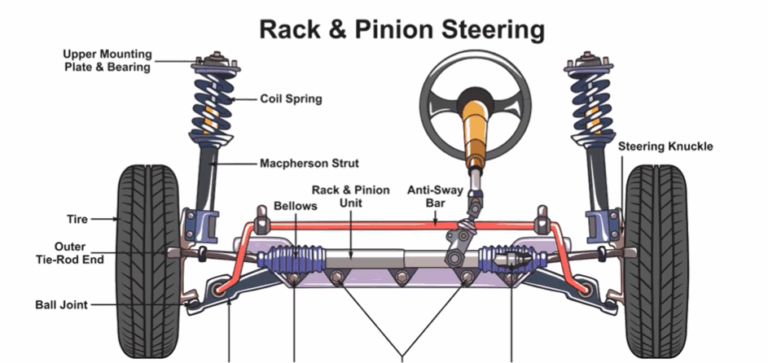
Every car has one per side on the lower arm. Trucks and many SUVs have a separate upper ball joint on their upper control arm. Most modern compact and midsize cars with MacPherson struts don’t have an upper ball joint, so the lower ball joint is doing the full job of holding the wheel’s pivot point in line. That’s why lower ball joint failure on a MacPherson car is catastrophic. Nothing else is holding the wheel.
How the Lower Ball Joint Works
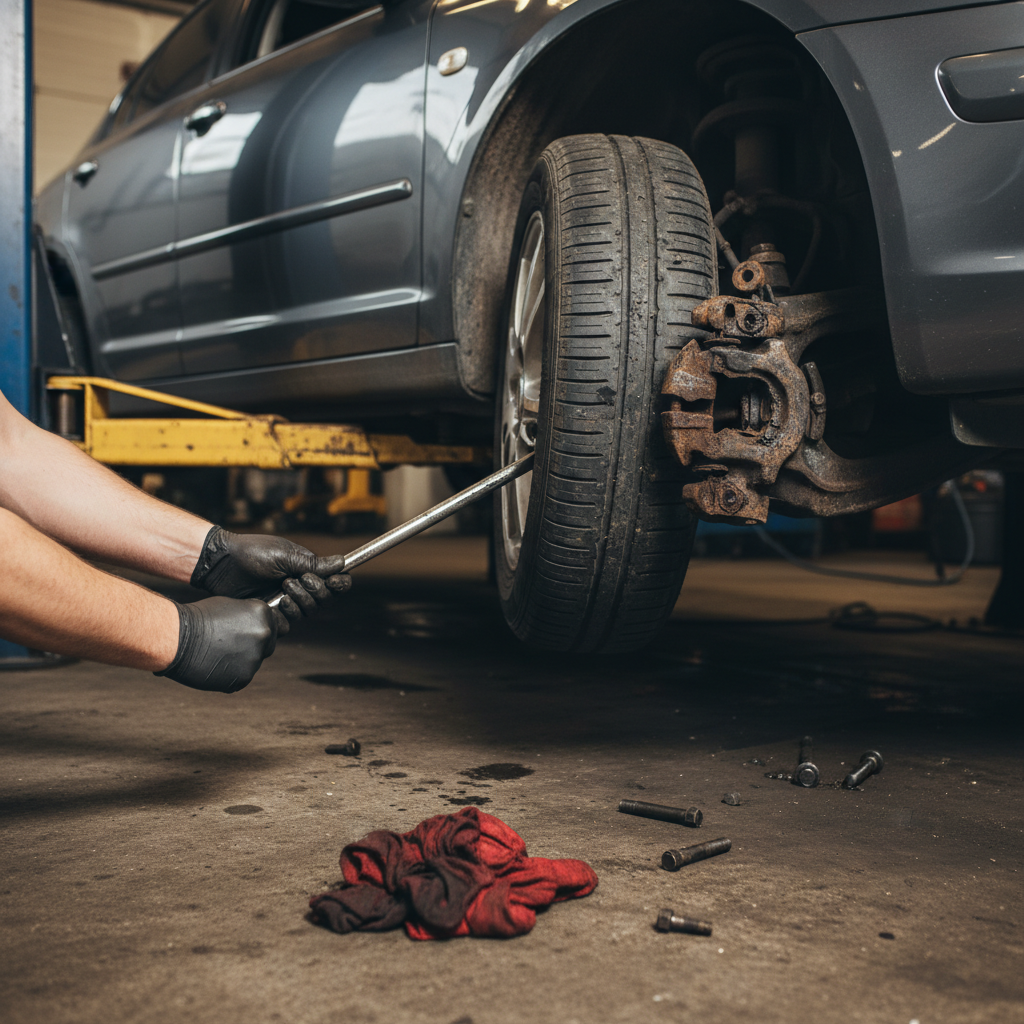
The physics are simple. The stud sits in a hardened steel socket, packed with grease and sealed on both ends. When the wheel turns, the stud rotates inside the socket. When the suspension moves up and down, the stud rocks inside the socket. The boot keeps the grease in and the dirt out.
As long as the grease stays clean and the socket hasn’t worn out, the joint can take 100,000+ miles of abuse. The moment the boot tears, grease escapes and road grit gets in. The abrasive paste chews the socket, and within a few thousand miles you’ve got play. Play becomes separation.
Load-Bearing vs. Follower Joints
Not all ball joints are under the same load. On a MacPherson strut car, the lower ball joint is a “follower,” because the strut carries most of the vertical load. On a short-long arm (SLA) setup like a truck, the lower ball joint is “load-bearing,” because it sits under the coil spring and takes the weight of the vehicle directly. Load-bearing joints wear faster. That’s why truck lower ball joints sometimes need replacing at 80K while a compact car’s lasts 150K+.
Serviceable vs. Integrated
Two designs. Serviceable ball joints are pressed into the arm with an interference fit and held by a retaining ring or cross-bolt. A shop with a press can remove and replace them. Integrated ball joints are riveted or welded into the arm at the factory. When they fail, the whole arm is junk. Integrated designs are more common on modern cars because they simplify manufacturing. They’re worse for owners, because a $40 joint becomes a $400 arm.
Signs the Ball Joint Is Failing
The ball joint gives you warning signs before it separates. Not many, and some of them get blamed on other parts. Here’s what to listen for.
Clunk on Turns at Low Speed
Pulling out of a parking spot, making a tight right, backing out of a driveway. A sharp clunk from the front as the wheel loads sideways. That’s the stud rocking in a worn socket. Bushing clunks happen on vertical hits over bumps. Ball joint clunks happen on turning and loading. Same arm, different ends.
Shaky Steering Wheel at Highway Speed
A loose ball joint lets the wheel move a few millimeters more than it should. At 55 to 65 mph, a few millimeters becomes a visible shimmy. Gets worse under braking because the caliper force loads the already-sloppy joint. Most drivers blame the rotors. New rotors don’t fix it.
Torn Boot with Grease on the Arm
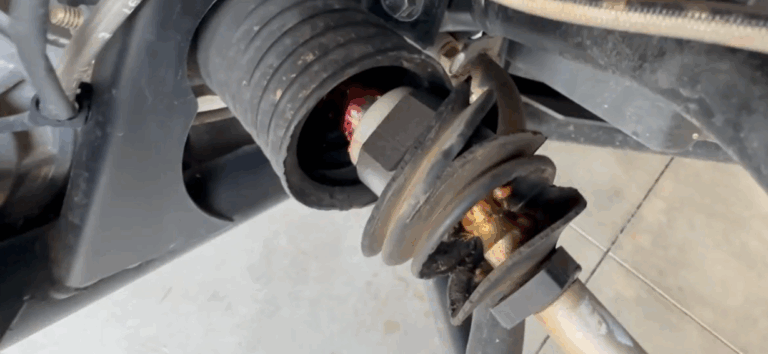
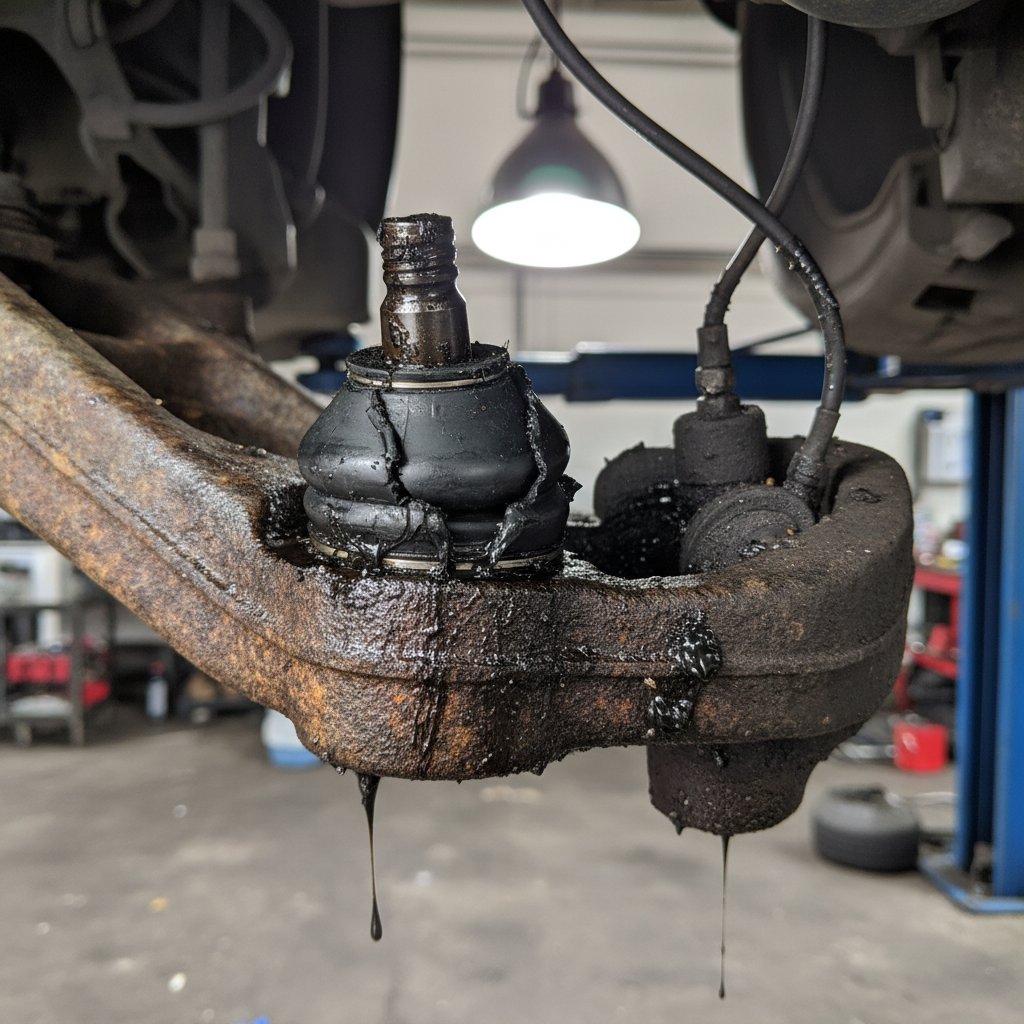
Car on jack stands, wheel off. Look at the boot on the outer end of the arm. Cracked, split, or gone, plus fresh grease slung on the surrounding parts means the seal is breached. From that point, the joint has weeks to months depending on road conditions.
Visible Play When You Pry
Pry bar under the tire, lift up. Watch the ball joint. If the stud moves in the socket, even a little, replace it. Any perceptible play means the socket is worn and the joint is on borrowed time. The full diagnostic checklist for lower control arm symptoms walks through this test and the bushing equivalent.
Uneven Tire Wear
Worn ball joints change where the wheel sits and scrub the tires. Not always inner-edge like a bushing does, sometimes a feathered or cupped pattern across the tread. AAA’s tire safety and maintenance guide flags feathered and inner-edge wear as classic suspension-related patterns, and the lower ball joint is one of the parts that causes it. If your tires look weird and your alignment keeps drifting, get the joint inspected before buying new rubber.
How the Ball Joint Fails
Ball joints rarely fail without warning signs, but the final event is fast. The socket wears, the stud develops play, and under load the stud pulls out of the socket entirely. The wheel folds under the car, the brake line usually snaps, and the car drops to the control arm. At low speed you hit a curb. At highway speed you steer into traffic.
The warning window is usually 2,000 to 5,000 miles between “I can feel something” and “this is dangerous.” If you’re already hearing clunks on turns and your alignment won’t hold, that window is shorter. Don’t highway-drive a car with suspected ball joint wear. Tow it if you’re not sure.
Cost to Replace a Lower Control Arm Ball Joint
Two paths, two prices. On a serviceable joint, you’re looking at $40 to $80 for the ball joint itself and $80 to $150 in labor at an independent shop that has a press. The joint presses out, the new one presses in, and the alignment after is $100 to $150. Total: $220 to $380 per side.
On an integrated joint, the whole arm gets replaced. Parts are $60 to $250 depending on vehicle. Labor is 1.5 to 3.0 hours per side. Total including alignment: $250 to $650. See the full lower control arm replacement cost breakdown for how vehicle class and labor rate move the number.
Trucks cost more. A half-ton truck’s lower ball joint is load-bearing and the socket is bigger, so the part alone can run $60 to $120 and the labor is longer because the coil spring has to come off. Heavy-duty trucks (F-250, Silverado 2500) can run $400 to $700 per side just for the ball joint.
Can You Replace Just the Ball Joint?
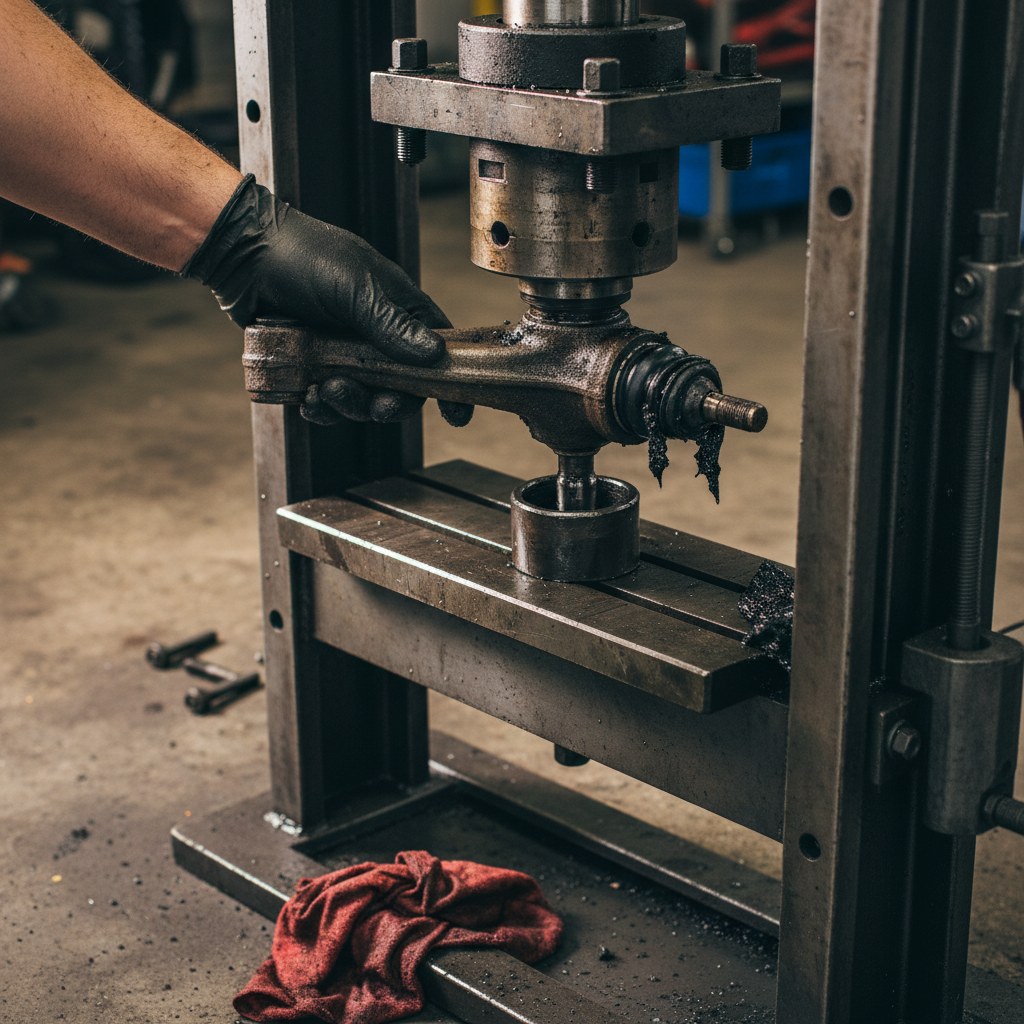
The answer depends entirely on your arm’s design, not on what you want. Pull the wheel, look at how the ball joint attaches to the arm. If you see a retaining ring, snap ring, or bolts holding the joint into the arm’s eye, it’s serviceable. Press it out, press a new one in. If the ball joint looks welded or riveted into the arm, it’s integrated. Replace the arm.
You can look this up in advance. A quick search for your year/make/model and “control arm ball joint serviceable” usually turns up the answer. When in doubt, the parts counter can tell you from the part number whether a standalone joint exists.
If you’ve got the serviceable version, Detroit Axle carries ball joints with a 10-year warranty. Most shops will install a customer-supplied joint without issue.
DIY or Shop?
Serviceable joint on a compact FWD car, with access to a 20-ton press and the right adapter cup: realistic intermediate DIY. You need to pull the arm or the knuckle, press the old joint out, press the new one in, and torque everything to spec. See lower control arm bolt torque specs for the exact pinch-bolt and castle-nut numbers per vehicle. Budget 3 to 5 hours your first time. The alignment after is non-negotiable and still happens at a shop.
Truck with a load-bearing joint, or any car with an integrated joint: shop work. The coil spring on a truck has to come off safely, which is not a driveway job without the right spring compressor. And on an integrated-joint car, you’re replacing the whole arm anyway, and that’s a more standard procedure a good independent shop will knock out in an afternoon.
FAQs
Can I drive with a bad lower ball joint?
Driving with a bad lower ball joint is dangerous and should be avoided entirely. Ball joint failure is the one suspension failure that actually puts you in an accident. When the stud separates from the socket, the wheel folds under the car and you lose all steering control on that corner. Short trips at city speeds to get to a shop are the maximum acceptable risk. If you’ve got visible play when you pry the tire or a torn boot with grease on the arm, tow it instead of driving it.
What does a bad lower ball joint sound like?
A bad lower ball joint sounds like a sharp metallic clunk, loudest when you turn the steering wheel at low speed or load the suspension sideways. Pulling into a parking spot, backing out of a driveway, or hitting a curb lightly will all produce the noise. Worn bushings make a duller thud on vertical hits over potholes. The ball joint is the sharper, quicker noise on turning or loading.
How long do lower ball joints last?
Lower ball joints typically last 90,000 to 150,000 miles on a follower-design car driven on good roads. Load-bearing truck ball joints wear faster, often failing at 70,000 to 100,000 miles. Salt-belt exposure and gravel roads shorten both. Once the boot tears and grease is lost, life span drops to weeks or months regardless of mileage.
Do I need an alignment after replacing a lower ball joint?
An alignment after replacing a lower ball joint is required, full stop. The joint holds the wheel’s steering pivot point, and any time you pop the joint loose the camber and caster reference shifts. Even a fresh joint installed with factory bolts can move the camber by a degree. That’s enough to chew the inside edges off your front tires in a few thousand miles. Budget $100 to $150 for a four-wheel alignment after the job.
What is the difference between a ball joint and a control arm?
A ball joint and a control arm are two different parts of the same assembly. The control arm is the metal or aluminum arm that connects the chassis to the steering knuckle. The ball joint is the pivoting connection at the outer end of the arm. On serviceable designs, the ball joint is a separate part you can replace. On integrated designs, the ball joint is built into the arm and they’re sold together. For a deeper look at the full assembly, see how the suspension components work together.