Replacing a wheel bearing typically takes 1.5 to 4 hours per wheel, but exactly how long depends primarily on the car.
On most modern vehicles that use a sealed hub assembly, the job is relatively straightforward and can often be completed in under two and a half hours. However, vehicles with pressed-in bearings require additional labor, since the old bearing must be pressed out of the steering knuckle and the new one pressed back in.
Corrosion, rusted components, and the overall condition of the suspension system can also increase the time required. In severe cases, extra disassembly or specialized tools may be needed, which can extend the repair beyond the standard time range.
Average Labor Time to Replace a Wheel Bearing
The majority of contemporary automobiles use sealed hub assemblies.
Average labor time in a shop:
- Front wheel bearing (hub assembly): 1.5–2.5 hours
- Rear wheel bearing (hub assembly): 1–2 hours
- Pressed-in bearing design: 2.5–4+ hours
Labor time does not usually double when both sides are replaced; overlapping labor steps can slightly shorten the total time.
Why Some Wheel Bearings Take Longer Than Others
Some wheel bearing replacements take longer than others because labor time is influenced by the vehicle’s construction, the bearing assembly’s design, and the degree of corrosion. While pressed-in bearings need more disassembly and specialized tools, which greatly lengthens the repair time, bolt-on hub assemblies are easier to remove and install.
1. Bolt-On Hub Assemblies
Prevalent on the majority of contemporary vehicles, SUVs, and sedans. The process:
- Remove brake caliper
- Remove rotor
- Unbolt hub assembly
- Install new unit
Time: Often under 2 hours.
2. Pressed-In Bearings (Slower)
Common on some older vehicles and compact cars. The process:
- Remove knuckle
- Use hydraulic press
- Press old bearing out
- Press new bearing in
This calls for specialized equipment and adds one to two more hours.
3. Rust & Corrosion Delays
Reddit and shop comments provide real-world mechanic insights:
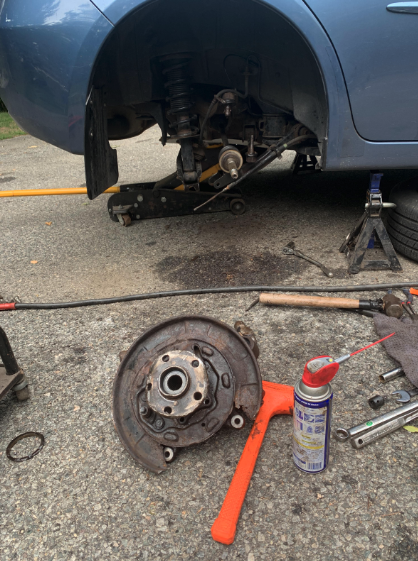
Seized hubs may result in an additional 30 to 90 minutes in rust-belt regions.
Technicians frequently make use of:
- Penetrating oil
- Slide hammers
- Heat to free the hub
If corrosion is extensive, a job that should take two hours to complete could take three and a half or more.
Is Replacing Wheel Bearings a Big Job?
Replacing a wheel bearing is a moderate to advanced repair depending on the bearing design. Pressed-in bearings need specific tools and are frequently better handled by a professional; vehicles with sealed hub assemblies are somewhat difficult and manageable for skilled do-it-yourselfers.
For a sealed hub assembly:
- Moderately challenging
- Requires a breaker bar, torque wrench, and jack stands.
- Intermediate DIY possible
For pressed-in bearings:
- Higher level of difficulty
- A hydraulic press is necessary.
- Often better left to professionals
It’s not a big engine repair, but it’s also not just an oil change.
How Many Hours Does It Take to Replace Wheel Bearings at a Shop?
Most repair shops bill:
- 1.5–3 labor hours per wheel
- Labor rates: $100–$150 per hour
That means labor alone typically costs:
- $150 to $450 per wheel
Total replacement cost (parts + labor):
- $300 to $800+ per wheel
- Luxury or AWD vehicles can exceed $1,000
Replacing both front wheel bearings could range from $600 to $1,600 depending on vehicle type.
Can You Drive With a Bad Wheel Bearing?
No, if your wheel bearing is damaged, you shouldn’t keep driving. A failed bearing may begin with a small noise, but it can rapidly get worse and cause problems with the brakes, steering, or in extreme situations, wheel separation.
Early signs and symptoms:
- Humming noise
- Slight vibration
Symptoms in the later stages
- Grinding
- Steering instability
- ABS sensor faults
Driving too long can:
- Damage the hub
- Damage the steering knuckle
- Damage ABS wiring
- Cause uneven tire wear
Wheel separation may result from a failed wheel bearing in severe circumstances.
Replacement shouldn’t be put off if you hear grinding rather than humming.
If you’re wondering whether you can safely drive while waiting to replace a worn bearing, you might also find our guide on how long you can drive on a bad wheel bearing helpful. It explains the risks of continued driving, what symptoms to watch for, and how quickly a failing bearing can worsen.
Front vs Rear Wheel Bearing Replacement Time
Front wheel bearings often take longer because:
- They handle steering loads
- They include ABS sensors
- They are more exposed to road debris
Unless they are incorporated with parking brake systems, rear wheel bearings can occasionally be faster.
FAQs
How long does it take to replace a wheel bearing?
Replacing a wheel bearing typically takes between 1.5 to 4 hours per wheel for most cars. This timeframe includes removing the wheel, brake components, and hub assembly, as well as installing the new bearing.
Because special equipment are required to force the bearing into position without destroying it, the operation can take longer—up to four hours—for vehicles that require press-in bearings or hub assemblies. The make and model of your vehicle, the state of the surrounding parts, and the mechanic’s background all affect how long it takes. The bearing must be installed correctly for safe handling, braking, and overall vehicle performance, therefore allowing enough time for the repair guarantees this. Front wheel bearings typically take longer because they are integrated with steering components, CV axles, and ABS sensors, which require additional disassembly and careful handling.
Does replacing both wheel bearings take twice as long?
No, it normally doesn’t take precisely twice as long to replace both wheel bearings on the same axle. Depending on the design, replacing both wheels usually takes 1.5 to 4 hours, but there are some labor processes that overlap.
For instance, it only takes one time to raise the car, remove the brake parts, and set up the tools. As a result, the overall work time is sometimes just under twice as long as the single-wheel estimate.
The vehicle’s use of pressed-in bearings or bolt-on hub assemblies, as well as the state of the surrounding parts, will still determine the precise time.