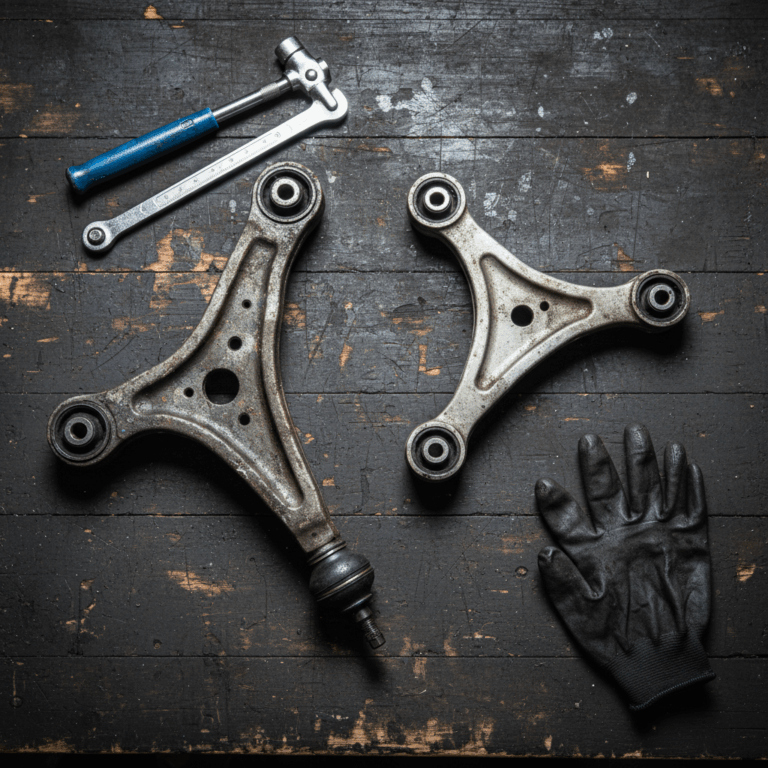
Not every car has both an upper and a lower control arm, but if yours does, they’re doing different jobs with different failure rates and very different replacement costs. The lower arm is the workhorse. The upper arm is the fine-tuner. Both matter, but confusing one for the other on a quote can cost you real money. Here’s the difference between an upper and lower control arm, which cars have each, and what you’re looking at when one of them needs replacing.
Key Points to Review
- Lower control arm: bigger, longer, load-bearing on most trucks. Does the heavy lifting of locating the wheel and carrying suspension forces.
- Upper control arm: smaller, shorter, fine-tunes wheel camber through suspension travel. Only exists on short-long arm (SLA) suspensions.
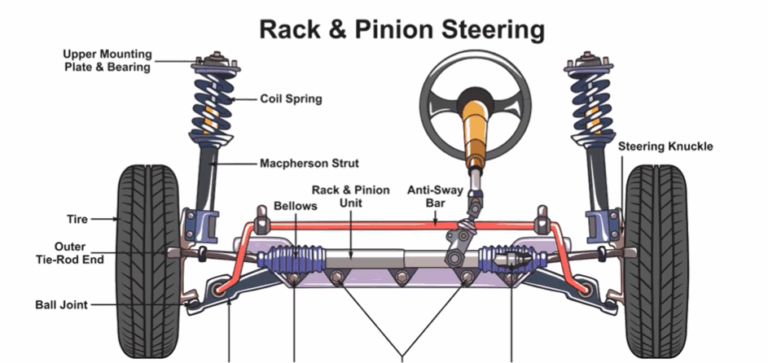
- MacPherson strut cars don’t have an upper control arm. The strut does that job.
- Lower arm replacement: $250 to $650 per side all-in.
- Upper arm replacement: $200 to $500 per side typically, because the arm is smaller and labor is usually shorter.
- If one is worn, both often are. Same miles, same bumps, same salt exposure.
Quick Reference: Upper vs. Lower Control Arm
- Location: Upper sits above the wheel center, lower sits below.
- Size: Lower is longer and heavier. Upper is shorter and lighter.
- Job: Lower locates the wheel and takes load. Upper controls camber change during suspension travel.
- Ball joint load: Lower is load-bearing on trucks, follower on MacPherson cars. Upper is almost always follower.
- Failure rate: Lower wears out first on most vehicles. Upper usually lasts longer.
- Cost: Lower runs $250 to $650 per side. Upper runs $200 to $500 per side.
What Is a Lower Control Arm?
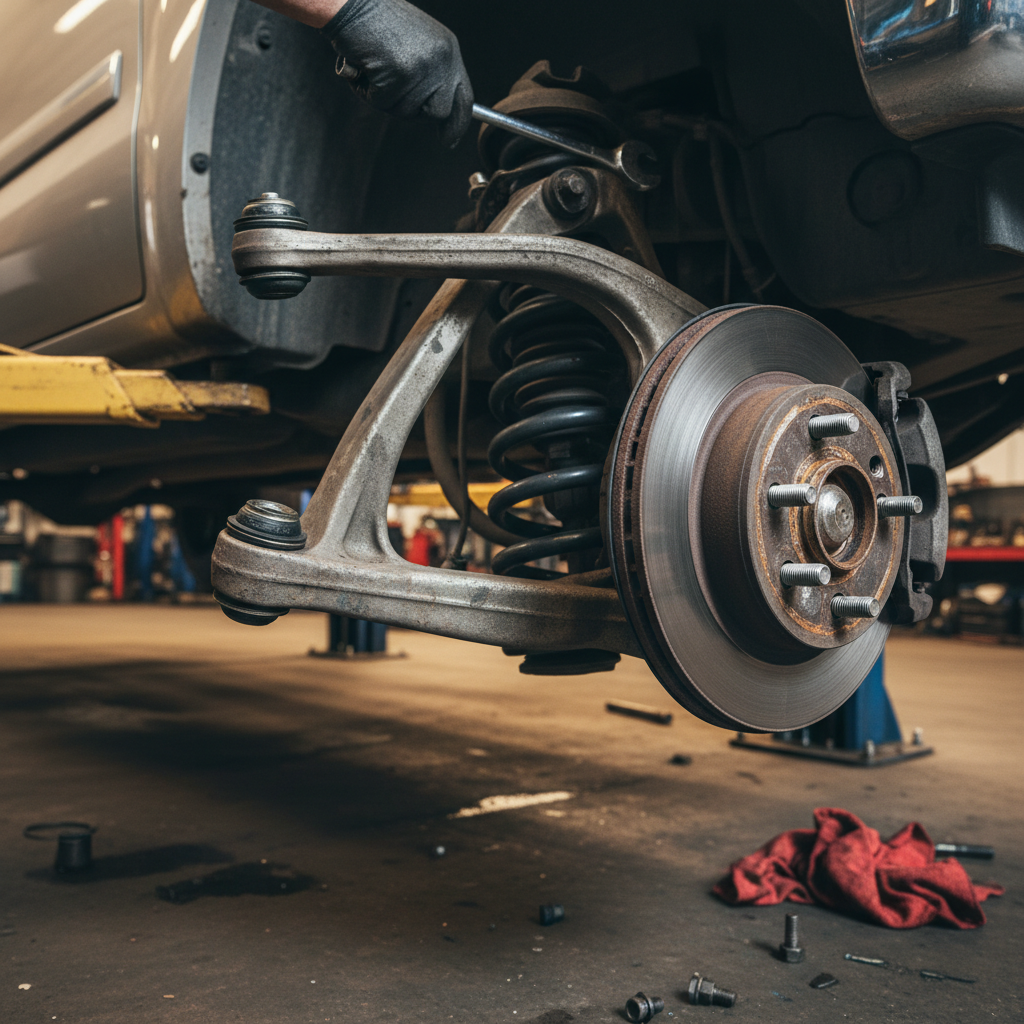
The lower control arm is the larger of the two arms, mounted below the wheel center, connecting the chassis to the bottom of the steering knuckle. It’s load-bearing on most trucks and body-on-frame SUVs, meaning the coil spring sits on top of it and the arm carries the weight of the vehicle through its pivot points. On MacPherson strut cars, the lower arm is a “follower,” because the strut takes the vertical load and the arm just handles lateral location.
Every car has a lower control arm. Every single one. It’s the non-negotiable piece of front suspension. For the full breakdown of how the arm works and why it matters, see what a lower control arm does.
What Is an Upper Control Arm?
The upper control arm is the smaller arm mounted above the wheel center, connecting the top of the steering knuckle (or the spindle) back to the chassis. Its job is to control how the wheel’s camber changes as the suspension moves up and down. When you hit a bump and the suspension compresses, the upper arm geometry pulls the top of the wheel inward slightly, keeping the tire flatter on the road through the compression.
Not every car has one. MacPherson strut cars use the strut to do what the upper arm does on an SLA setup. If you look under a compact FWD sedan (Civic, Corolla, Camry base suspension), you’ll see a lower arm and a strut. No upper arm. Look under a half-ton truck or a 3-Series, and you’ll see both an upper and a lower arm, no strut.
Which Cars Have Both?
Short-long arm (SLA) suspension uses both. That’s the design you find on:
- Half-ton and full-size trucks (F-150, Silverado, Ram 1500, Tundra)
- Body-on-frame SUVs (Tahoe, Suburban, Sequoia, 4Runner)
- Rear-wheel-drive and all-wheel-drive luxury sedans (BMW 3/5/7 Series, Mercedes C/E-Class, Audi A4/A6)
- Performance cars (Corvette, Mustang GT, Camaro)
MacPherson strut suspension uses only a lower arm, no upper. That covers:
- Most compact FWD cars (Civic, Corolla, Sentra, Cruze)
- Most midsize sedans and crossovers (Camry, Accord, RAV4, CR-V)
- Most FWD-based compact SUVs
A quick way to tell: look at your front suspension. If you see a vertical shock absorber bolted to the top of the knuckle with a coil spring around it, that’s a MacPherson strut, no upper arm. If you see a horizontal arm above the wheel with a ball joint on its end, that’s an upper control arm and you’re looking at an SLA setup.
Head-to-Head Differences
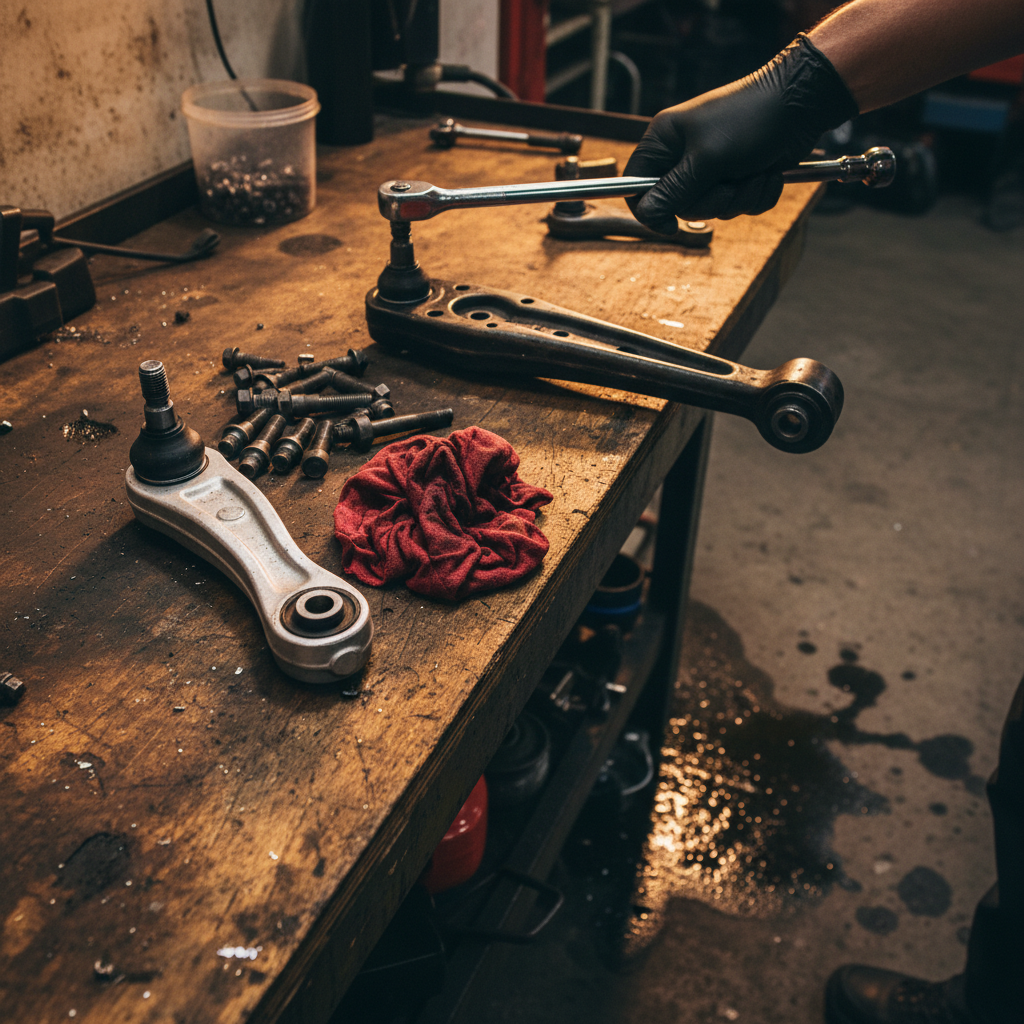
The arms look similar at a glance but they’re built and behave differently. Here’s how they compare across the factors that actually show up at the counter.
Load and Stress
The lower arm takes the heavier loads on an SLA setup because it sits closer to the wheel center and carries the spring. On a truck, the lower ball joint is load-bearing, meaning the weight of the vehicle transfers through it. That’s why truck lower ball joints wear out at 70,000 to 100,000 miles, faster than the upper. The upper arm’s ball joint is a follower and usually outlasts the lower by 30,000+ miles.
Bushings
Both arms have bushings at their chassis mounts, and both sets wear out eventually. The lower arm’s bushings usually fail first because the arm is longer and sees more leverage load. Hydraulic or forged-rubber bushings on modern European cars can last 150,000+ miles on either arm. Basic stamped-rubber bushings on older trucks go at 90,000.
Ball Joints
Both arms have a ball joint at their outer end. The lower ball joint is the one you can’t ignore, because on a MacPherson car it’s the only lower pivot and on a truck it’s load-bearing. If the lower separates, the wheel folds under the car. Ball joint and control arm failures have driven manufacturer recalls catalogued by NHTSA’s recalls database, which is why a worn lower arm is not something to defer. Upper ball joint failure is less catastrophic, because the lower arm still holds the wheel, but it still causes clunking and handling problems. See how the lower ball joint works and fails for the full breakdown.
Replacement Cost
Lower control arm replacement at an independent shop runs $250 to $650 per side in 2026, parts + labor + alignment. Upper control arm is usually $50 to $150 cheaper per side because the arm is smaller and easier to reach. On a truck with a torsion-bar setup, the gap narrows because both arms take real time to access. For a full breakdown see the lower control arm replacement cost guide.
Replacement Complexity
The lower arm is the harder swap on most trucks because the coil spring or torsion bar has to be released safely. The upper arm usually comes out with a few bolts and a ball joint separator. On a MacPherson car, the upper arm question is moot. You just have the lower.
Symptoms of a Bad Upper or Lower Control Arm
The symptoms overlap, which is why people get the wrong quote all the time. Both arms can clunk, both can cause uneven tire wear, both can make the alignment drift. Here’s how to tell which is which.
Lower arm symptoms: clunking over potholes and speed bumps (bushings), clunking on low-speed turns (ball joint), inner-edge tire wear, alignment that won’t hold, visible play when you pry the tire at 12 and 6. AAA’s tire safety and maintenance guide points to suspension wear and alignment drift as leading causes of premature tire wear, and control arm bushings and ball joints are two of the main culprits. The six warning signs of a bad lower control arm covers this in detail.
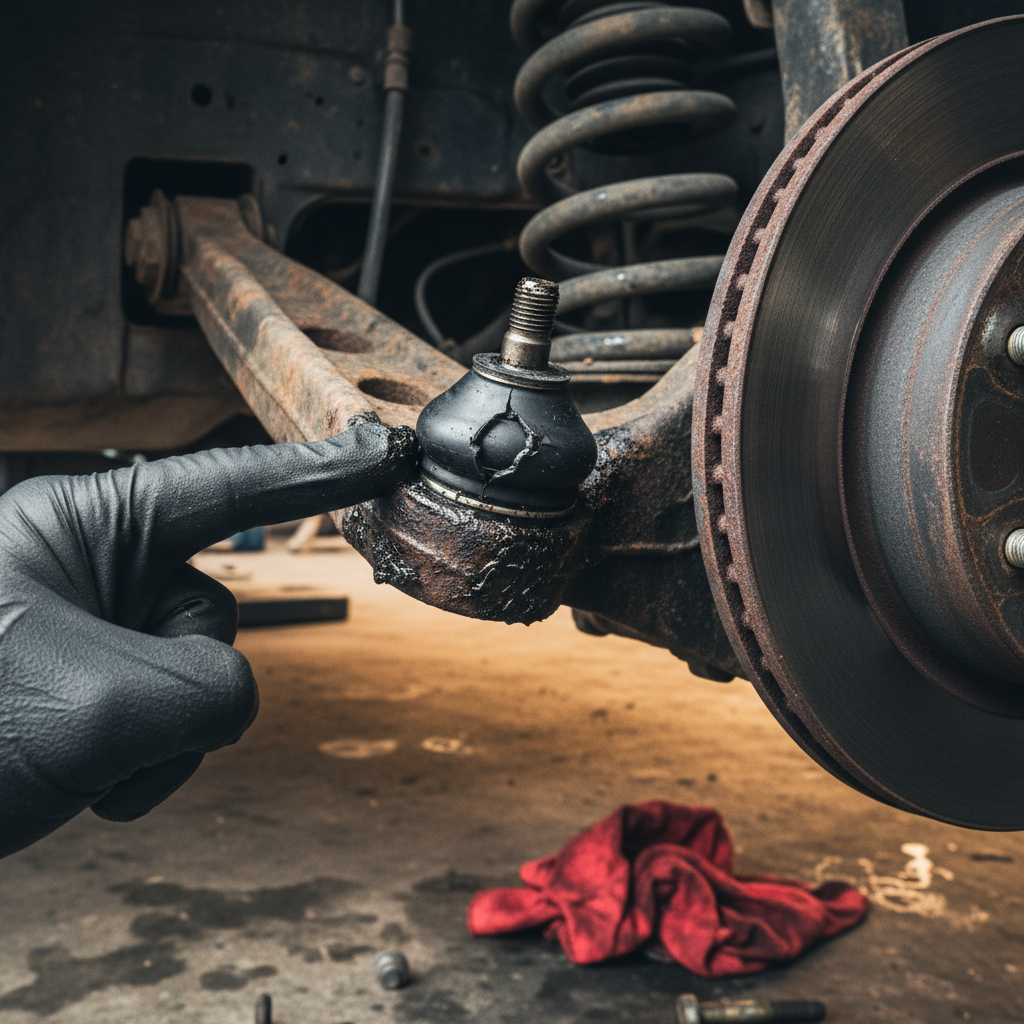
Upper arm symptoms: clunking over larger bumps and during suspension rebound, uneven camber changes during cornering (the car rolls more), visible play when you rock the tire at the top of the wheel, torn boot on the upper ball joint. On trucks, upper ball joint wear often shows up as a “popping” sound when the suspension fully extends (going over a crest or backing over a curb).
When You Need to Replace Each
Replace the lower arm when the bushings are cracked or separated, the ball joint has perceptible play or a torn boot, the arm is visibly bent, or the alignment keeps drifting after a fresh alignment. Don’t delay on a lower ball joint failure, because the separation mode is the wheel folding under the car at speed.
Replace the upper arm when its ball joint shows play, its bushings are torn, or it’s visibly damaged. On a truck, both upper ball joints tend to go within 20,000 miles of each other, so if one has play, check the other. If your truck is over 100K and both uppers have any play, replace both while the shop is in there. You’ll save labor, and the shop does one alignment.
Both arms use similar parts internally. Detroit Axle carries control arm assemblies for both upper and lower positions on most domestic and import vehicles, with a 10-year warranty on the arm and its bushings and ball joint.
FAQs
What is the difference between upper and lower control arms?
The difference between upper and lower control arms comes down to size, load, and location. The lower control arm is bigger, located below the wheel center, and carries the primary suspension load on most vehicles. The upper control arm is smaller, located above the wheel center, and controls how the wheel’s camber changes as the suspension moves. MacPherson strut cars only have a lower arm, with the strut doing the job of the upper arm. Short-long arm suspension (trucks, body-on-frame SUVs, rear-wheel-drive luxury cars) has both.
Which wears out first, upper or lower control arm?
The lower control arm wears out first on most vehicles, particularly the lower ball joint on trucks where it’s load-bearing. For the deeper lifespan story (how long either arm typically lasts, what shortens it, and when to expect failure), see how long lower control arms last. The lower arm takes more force because it sits closer to the wheel and carries the spring load on SLA setups. Expect lower arm bushings and ball joints to show wear at 70,000 to 100,000 miles on trucks and 90,000 to 150,000 miles on cars. Upper arms usually last 30,000+ miles longer on the same vehicle.
Can you replace just the upper or just the lower control arm?
You can replace just the upper or just the lower control arm, and shops do it all the time. Unlike shocks and struts where replacing in pairs is strongly recommended, you can replace one arm at a time if only one is worn. That said, if both arms on the same side have similar mileage and the suspension has been through the same conditions, doing both at once saves on labor and alignment. Most shops will offer a discount on the second arm if it’s done during the same visit.
Do both control arms need an alignment after replacement?
Both control arms absolutely require an alignment after replacement, whether you replaced just one or both. The arms set the wheel’s camber and caster reference points, and any time you pop the arm loose those references shift. Even a fresh arm installed with factory torque on the original bolts can move the camber by a full degree. That’s enough to destroy your inside tire edges in a few thousand miles. Budget $100 to $150 for a four-wheel alignment after either repair.
Does my car have an upper control arm?
Whether your car has an upper control arm depends on the front suspension design. If your car uses MacPherson strut suspension (the majority of compact and midsize sedans and crossovers), there’s no upper arm. The strut handles that job. If your car uses short-long arm (SLA) suspension (trucks, body-on-frame SUVs, rear-wheel-drive luxury sedans, most performance cars), it has both upper and lower arms. A quick visual check from underneath the wheel well will tell you: a vertical strut through the top of the knuckle means MacPherson, a horizontal arm above the knuckle means SLA.